Una introducción
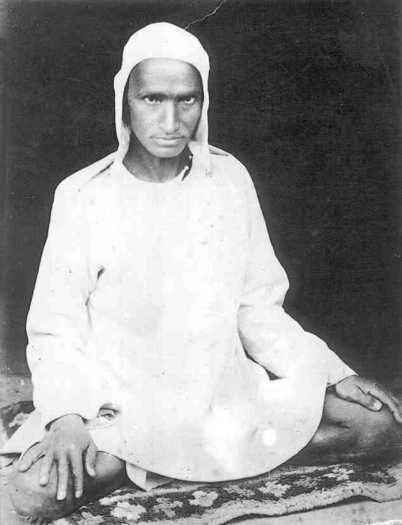
Bhagavān Śrī Haiḍākhāṇḍī Bābājī
El ensayo introductorio de Parichayāmṛt, de Śrī Charaṇāśrit — «Mahendra Bābā» — reproducido aquí íntegramente.
Esta introducción se muestra en inglés y en hindi, tal como aparece en el libro. El resto del sitio está disponible en su idioma.
The unbroken flow of the Lord's divine play streams on forever, without hindrance. The surging wave of that play, woven of unequal qualities, is the natural form of the ocean of creation. By the mutually opposing powers of this play, all of us — the whole order of living beings — are ever held in check. Bound by countless nooses, the living being loses its way in the wheel of worldly existence and goes on spinning. Every creature desires happiness, yet abandons the very acts by which happiness would come. It becomes bewildered, unable to decide what to do; no settled awareness can find a resting-place in its heart. Just as, when a traveller falls into confusion about direction, it becomes utterly impossible for him to reach his destination, so too it is hard for the soul, borne along in the fierce current of this three-guṇa creation, to cross this impassable ocean of the world.
When the living being — "amṛtasya putrāḥ," a child of immortality — forgets its own self-awareness and begins to grow attached to the insentient, non-self objects around it; when the goal of human life comes to rest in physical enjoyment alone; then falsehood and misconduct reach their extreme. Aversion arises toward the sādhanās sanctioned by scripture, which grant every desired fruit; disbelief grows toward the true words of the great ones. Then Śrī Bhagavān, assuming various bodies, shows us the right path. Himself observing the scriptures, He makes plain for us the unerring road to both worldly welfare and final liberation. He gives us firm inspiration to obey the command of the great ones. In the hearts of beings devoid of sāttvic faith, He plants a devotion full of goodwill and lasting steadiness.
Just as His cosmic (gross) power is beginningless, imperishable, and undiminishing, so too is His power of play — inconceivable, imperceptible, and infinitely deep, ever flowing like a stream. It rests upon the developmental progress of the awakened inner being, how far it can assimilate the play-form of the Imperishable One. This divine, three-guṇa play is wholly subject to the One who impels it. Full realization and inward grasp of the power of play is possible only by the grace of the Wielder of Play. All the wise are of one mind in this: that the attainment of God, and the knowledge of Him, is achievable by grace alone.
Our eternal teachers, the great ṛṣis of dharma, have described four forms of Śrī Bhagavān — Name, Form, Play (līlā), and Abode (dhāma). In the divine Śrī body of the Lord, these four principles are, as it were, the fourfold inner faculty. If a fortunate aspirant comes to have faith and trust in even one of these four divine principles, he is made wholly fulfilled.
Both the aspirant and the goal are, in their moods, mutually dependent. As is the devotee's nature — "tad- vismaraṇe parama vyākulatā," that in forgetting Him is the deepest anguish — so, in forgetting the Supreme Soul, the devotee grows restless. In the same way, Śrī Bhagavān too, becoming as one bereft of His devotee, walks behind His heart's wealth, the wholly surrendered one. He takes the devotee's entire burden upon His own head. In the Śrīmad Bhāgavata there is the clear command of the Lord: "I am subject to My devotees." According to this generous vow, the sportive Lord — an ocean of compassion — chose the Kūrmāñchal region of the world-renowned Himālaya as the field of His play. Śrī Viśveśvara, pervading every atom of the universe, revealed a transcendent and beautiful character, full of majesty and sweetness. In the form of one particular person, the great Avatar, the Wielder of Play — by His boundless compassion, and by His inconceivable, indivisible power of play, was uplifting ordinary beings such as us, laden with degraded qualities. How could the naturally narrow vision of man be subtle enough to comprehend the play of this Maheśvara — the great Man, the transcendent Man, the Primal Being of the human creation? The transcendent character of that most glorious Maheśvara lies utterly beyond ordinary speech and ordinary sight. He dwells within the very world of men; His imperishable Śrī body too is like that of the world — and yet He is wholly beyond this world. For the welfare of the world, Śrī Viśvanātha takes on a world-body, an earthly body; yet, wearing that immortal, imperishable divine body beyond the five elements, He dwells unceasingly within the beings of the whole universe. And still it remains a supreme wonder that, to this day, no one has been able to say of Him, "It is precisely thus."
This is the fixed truth: "īśāvāsyam idaṁ sarvam" — this entire moving and unmoving world is the very dwelling-place of Śrī Bhagavān.
mattaḥ parataraṁ nānyat kiñcid asti dhanañjaya ǀ (Gītā)
With His own holy mouth, Śrī Bhagavān has said: O Arjuna! There is nothing beyond Me. In Me are all things, and in all things I am fully pervading. As thread runs through beads and beads upon the thread, so am I woven through the whole creation, through the endless universes. So great is our identity with Him, so complete our non-difference, as though He and we were utterly one. Know it for certain — we alone are His. That very Lord of Being-Consciousness-Bliss has given us too an inexhaustible treasury of Being-Consciousness-Bliss. He has fashioned suitable means for the fulfilment of all our needs; and yet we are not content — an intense longing for one particular fulfilment torments us always. Scripture, therefore, proves this: that until we have the vision of that Supreme-beyond-the-supreme, the knot of our heart, our mental doubt, and the dry burden of the deeds enjoined by śruti and smṛti will never let us find peace. The peace of God, the eternal peace, will be possible for us only when Śrī Bhagavān becomes the very object of our sight.
It is to fill this very lack that Śrī Bhagavān — the Wielder of Play, both manifest and unmanifest — descends, out of unmotivated compassion, before our very eyes, in one particular land and one particular age, in the form of a supreme man, a best among men. The community of the world calls Him "Avatar" and expresses its reverence. The moral order He proclaims in the world becomes, in the form of some particular faith — that is, a system of conduct supported by the perspective of the time — a means by which countless beings are made partakers of welfare.
The great Avatar of whom we here set out to speak is renowned among the common people especially by the name of "Bābājī." From what age, by what method, this Viśvanātha, the uplifter of the world, has been conducting His play — all these matters no one has yet been able fully to comprehend. The śruti says: "vijñātāram are kena vijānīyāt" — He who is the knower of all, by whom is He to be known?
In the lovely region of Kumāū̃, amid the pure and enchanting mountain-ranges of the holy Himālaya, the introduction to this great Avatar, Śrī Bhagavān "Bābājī," was found.
It was first in the latter half of the eighteenth century of the Christian era that, out of love for His devotees, He began to come and go among the community of people — though He forever moves in a body of light. Where the bounds of space and time do not reach — yet, from the later record of His deeds, it appears that from around the year 1880 He, in His grace, began to bestow the mercy of His darśan upon ordinary people as well. By that time He had already become greatly renowned in Kumaon. As a great saint, a supreme ascetic, an ūrdhvaretā celibate, a Yogīrāj possessed of the eight siddhis — under many names such as Droṇāchārya, Kṛpāchārya, Hanumān-Śiva, Tryambaka, Pahāṛī Bābā, Siddha Bābā, and Mṛtyuñjaya Bābā — He was worshipped. Sādhus, brāhmaṇas, accomplished ascetics rich in penance, and seekers and thinkers alike held the firm conviction that Śrī Bābājī was God; that this Avatar was altogether extraordinary. Just as the six divine majesties (ṣaḍaiśvarya) dwell naturally in Bhagavān, so in this Śrī body was the astonishing seat of all powers. Countless times they saw with their own eyes: the dead restored to life; the illiterate granted eloquence and the power of extempore verse; the childless blessed with sons; men beset by financial ruin made secure by the boon of provision and protection; the whole array of siddhis becoming handmaids to seekers who longed for divine bliss; beings afflicted by disease and scorched by the threefold suffering gaining great health and imperishable peace. And the seekers of liberation, the aspirants who longed for release, came not only from all across India, but from Europe as well (many a company of seekers from Western lands), and from the vast community of accomplished lāma-yogīs of Tibet — all came into His fearless and generous refuge and attained the fulfilment of their own hearts' desire. Great seekers of every differing school and sect, taking refuge at the feet of the perfected Lord, had their heart's aims fulfilled. After wandering for years through the holy play-ground of "Bābājī" in the Himālaya, and after meeting many noble souls, this much can be said of Him in brief: that the divine manner of living, and the atmosphere full of divine majesty, which the scriptures and Purāṇas describe of the Lord in His avatars — or as in the life-accounts of the God-devoted ones like Jaḍabharata, Lomaśa, and the sons of Brahmā (Sanaka and the rest) — in that same manner He remains ever and unceasingly absorbed, and fulfils those who take refuge in Him by granting His holy darśan.
His extraordinary personality, His vast form, His unheard-of harmony of compassion and power, and His boon-bestowing hand toward the poor and lowly, began of themselves to draw the mind of human society toward Him. From a secret mountain-cave of the Himālaya, the tiny particle of world-redeeming grace began to spread to the ends of the earth. Śrī Devarāj (Indra) with his retinue began to offer his reverence with showers of flowers; the King of Seasons brought all his splendour and abundance; men and women, beholding the tangible fruit of the merits of many lives, made their births fruitful. Accomplished ascetics rich in penance, attaining the radiant fulfilment of their sādhanā, were made wholly fulfilled; the piteous cry of the afflicted and the poor began to bear fruit. The wondrous and supernal play of this great Avatar, Śrī Bābājī, had stirred the whole region with a most extraordinary and holy spiritual movement. The earth grew full of wealth and grain; the threefold stream of truth, simplicity, and love began to well up in the heart of every person; sorrow, poverty, and disease began to flee.
His body is not of the earth. The Lord — the wish-fulfilling tree of His devotees' desires — has assumed this mysterious Śrī play-body only for the contentment of His beloved ones. His eating, sleeping, moving about, rising, and sitting are all unlike anything ordinary. Learned men and great seekers prayed to Him: "Bābā! Why does Śrī Bhagavān take on the form of a man?" Śrī Bābājī Mahārāj, in His grace, replied: "Man could never succeed in the knowledge, meditation, or remembrance-and-prayer of God, if God did not take a human form." And so the Lord — the very root of unmotivated compassion — for the ease of our path to God, being formless, assumes one particular form. To sit swiftly and easily upon the throne of our hearts, He takes on a body of the same shape as our own; the Lord beyond all principles appears as though subject to them. The purpose of all analysis of that Infinite One — of His nature and disposition, of inference and proof and the rest — is only this: that, whatever we may be, we should take refuge in Him.
After much inquiry into Him, this alone was the conclusion: that Śrī "Bābā" Mahārāj had no fixed programme. Wherever Śrī Mahārāj went, there, of themselves, without any kind of signal, thousands of men and women would gather. On hearing news of His arrival, rare was the person who could stay at home. There, no one could put a question; from His mere darśan the mind grew wholly serene. How many great scholars, ministers of state, great social reformers, and servants of the nation, and kings and nawabs, would come! The ultimate fruit of instruction, the very essence of sādhanā, the effortless companionship of the goal, and the Brahmic state of the knowers of Brahman — all these excellences, in His revered presence, were forever equally available to all. Ever a smiling face, compassionate eyes, generous conduct, a lean frame, childlike gestures, a kurtā, a cap, and a dhotī — these bodily features were a source of supreme joy to all. In food He took very little grain; buttermilk especially He would drink.
Bābā's aged loving servants related that in the month of Māgh, when snow falls here up to three feet deep, we had to beg buttermilk from house to house for Śrī Mahārāj. He would drink buttermilk as though it were water. In His waste there was a strange fragrance, and within an hour or two the excrement would turn to mere earth. When He opened His fist, the thousands of devotees present would grow intoxicated with a divine fragrance. His hair did not grow; He did not sleep; if a garment was thrown over Him, He wore it, and if not, He neither ever asked for a garment nor, when garments were present, ever used one of His own accord. Devotees would offer very costly garments, coin, and many other precious things. He would not even look at those offered objects. Yes — at times, for the devotees' delight, He would, like a child, play with those things for ten or fifteen minutes, and then, whatever might become of them, whoever might carry them off, He made no arrangement. Earth and precious things were all alike to Him. Foe and friend, slanderer and praiser, sinner and saint — in His compassionate gaze all were equally worthy of mercy. The many-formed Śrī Bābājī appeared before us in the form of a saint. This great Avatar, Śrī Bābājī, becoming the Sadguru, made the soil of Bhārata blessed throughout the world, and gave special glory to the Kūrmāñchal region. In the Divya Kathāmṛt it is written:
When even Śeṣa and the śrutis grow unable to sing His glory, what can I, the lowly "Charaṇāśrit," write? "Jo si so si tava caraṇa namāmi" — whatever You are, You are my adored one, my Supreme Lord. That most compassionate, most glorious Bābā Bhagavān, the redeemer of the world, moves about in the form of a Sadguru. His human and compassion-filled manifestation has taken on a sweet and merciful form; the tender-hearted, the uplifter of the fallen, Tryambaka Bābā, has — as one radiant jewel upon the string of the Sadguru's rosary, His own inseparable limb — granted to the blind and world-bound the simplest means of attaining the light of new consciousness, of Being-Consciousness-Bliss. Concerning Him, the sound rising today from countless throats is this: that Śrī Sadgurudev Jī Mahārāj is such a compassionate Lord, that upon taking refuge at His feet, the whole journey of life is happily made fruitful. However many the faithful, the surrendered souls of Śrī Mahārāj, that have thus far been met — all are seen to be happy and at peace. The world-renowned solitary sage, the ascetic who makes his home in a natural mountain-cave, the greatly famed and radiant celibate who sustains his life on the unasked-for roots and tubers given by Mother Earth, by the mere holding of whose foot-dust the threefold cravings — this-worldly, other-worldly, and all the rest — are destroyed; such is our redeemer of the fallen, the wise and brilliant One, wholly beyond space and time, by whose grace the science and raising of the five sheaths (pañca-kośa) and the six centres (ṣaṭ-cakra) happens effortlessly — He is the most radiant Sumeru-jewel of the famed rosary of the Sadguru: