English ویرایش
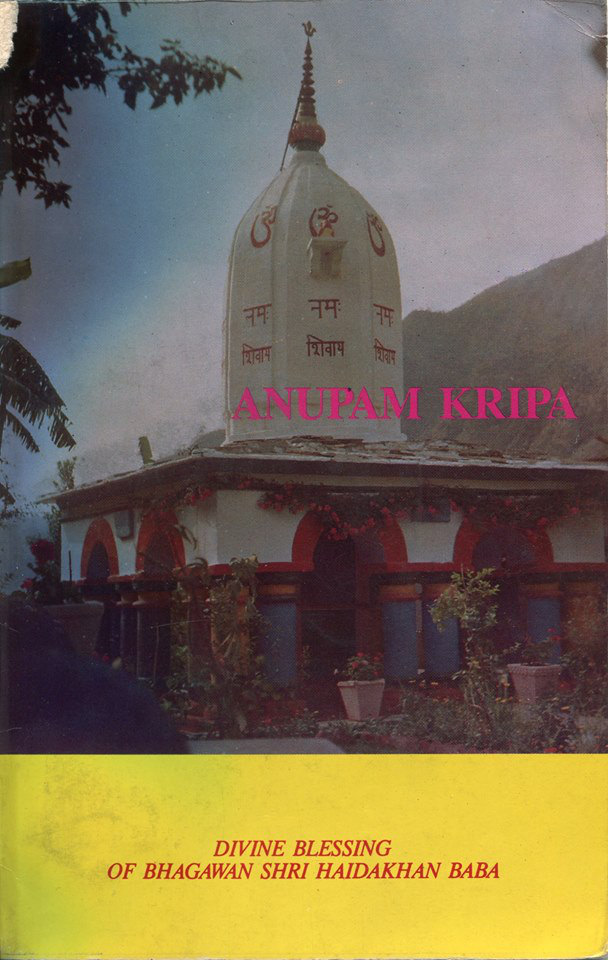
Anupam Kṛpā
Bhagavān Śrī Haiḍākhān-vāle Bābā kī Anupam Kṛpā
Śrī Mahendra Mahārāj — "Śrī Charaṇāśrit" (Kṛpā-pātra, Brahmachārī Bābā)
01
The Peerless Grace — the Divine Blessing of Bhagavān Śrī Haiḍākhān Bābā
Original Hindi: Bhagavān Śrī Haiḍākhān-vāle Bābā kī Anupam Kṛpā
by Śrī Mahendra Mahārāj (Śrī Charaṇāśrit · Kṛpā-pātra · Brahmachārī Bābā)
Hindi to English: an anonymous translator, given the task by Śrī Haiḍākhān Bābājī
at Vṛndāvan in October 1972 (preface dated Jaipur, 12 September 1972)
English to Italian: Natascia Valentini ("Tara bianca")
Italian to English: this library, 2026 — the 1972 English edition being lost to us
02
Divine Blessing of Bhagavān Haiḍākhān Bābā
Original Hindi: Bhagavān Śrī Haiḍākhān-vāle Bābā Kī Anupam Kṛpā
by Śrī Mahendra Mahārāj (Śrī Charaṇāśrit / Kṛpā-pātra / Brahmachārī Bābā)
Hindi to English: anonymous translator, assigned by Śrī Haiḍākhān Bābājī at Vṛndāvan, October 1972 (preface dated Jaipur, 12 September 1972)
English to Italian: Natascia Valentini ("Tara bianca")
This file: the English text, restored from the Italian, with all 22 photographs kept in their original positions.
Status: ENGLISH — translated from the Italian.
TRANSLATOR'S PREFACE
In October 1972, Pūjya Śrī Śrī 1008 Haiḍākhān Bābājī gave the translator the task of rendering Anupam Kṛpā (The Peerless Grace) from Hindi into English. It was during one of those periodic visits to Vṛndāvan made for the sake of being within the aura and the grace of Pūjya Bābājī. There seemed to be two reasons behind the assignment, one general and one particular: an opportunity for the English-reading public to come into contact with one of the major writings of Śrī Mahendra Mahārāj, and an incentive for the translator to learn Hindi, since his knowledge of it was barely rudimentary.
The translator therefore claims neither a textual nor a literal translation. A halting and even a faulty rendering may perhaps be discovered by the more able. Whatever shortcoming is found in the translation, the translator alone is responsible for it. The task was difficult, first of all because of his scant knowledge of Hindi, but also because of the intrinsic difference of spirit between the two languages. Not only are certain words impossible to translate in their full meaning; the deep devotion of the feelings expressed in the original is hard to convey in English.
So too the profoundly metaphysical and mystical ideas do not yield to the language of the translation. The translator has therefore attempted to stay on safe ground and has tried to translate as literally as possible, realising fully that such a method, unlike a free translation, very often results in stilted and pompous mannerism. The translation is offered as a labour of love at the sacred feet of Pūjya Bābājī, for whatever good it may serve. May it also inspire others, who cannot read the original, to a deep and heartfelt devotion for Pūjya Bābājī.
OM NAMAH SHIVAY.
JAIPUR, 12 September 1972
Thou art gone;
The Light that shone so briefly, bringing healing to our hearts from stress and strife, has faded, and we grow weary with weakness — longing for Thy presence.
A brief spell of brightness, then the desolate night;
A tree of brilliant splendour, from the heavenly height;
A star has taken its flight from our presence,
and now all is darkness, with no ray of relief.
As a child bereft of its mother's love and healing presence does not understand her absence, but weeps and yearns for the clasp of her loving arms, so I, desolate, do not understand, but only long once more for a sight of Thy beautiful form. We wait and we watch for Thee.
Through long ages I sought Thee, from life to life, wandering on, knowing neither peace nor joy, and finding no rest.
How can a part torn away from its whole find rest, except by merging once again to be whole?
All shining things are full of beauty: the sweet flowers, the tall trees, the little ripples of the streams, the chirping of sweet birds in the branches, the play of small children, the glorious colours of the sunset, the sighing of the wind and its rustle through the leaves, the dewdrops of the early morning on the green blades of grass, the music of the waves of a stormy sea, the magnificent colours of the rainbow. A thousand other things besides once soothed this restless heart like balm; but now it is Thy absence that moves me more. Joy has taken flight, and all is darkness.
This stubborn heart demands a constant sight of Thy splendid form. As a starving beggar, given a morsel too small to still his hunger, feels the gnawing of his emptiness more keenly than before, so I, having tasted Thy Divine Grace, can scarcely live now except in Thy presence. As a fish cast out of the water gasps for its natural home, so, Lord, do I languish in Thy absence. Thou All-compassionate One, come quickly and save this frail heart.
ON BĀBĀJĪ LEAVING VṚNDĀVAN, 22 OCTOBER 1972
Bābā, our Beloved, our guru and our friend,
Bereft of Thy presence, Thy love and Thy strength;
Thy bhaktas (devotees) are calling — oh, heed Thou their cry,
Behold in what darkness and anguish they lie.
Dimmed lie the courts of Thy temple and shrine,
Faded the flowers — their offering and mine;
Gone is all the light, all the joy and sweet grace
That shone upon every bhakta from Thy sacred face.
At morning and evening the cymbals and drum
That filled Thy courts with fervent devotion;
Scattered through life, heedless, neglected and dead,
And all around are downcast and sad.
Thy smiles are no longer mirrored in the flowers,
They feel not Thy love that came falling in showers;
They hear not Thy voice that echoed around,
In the courts of Thy temple, sweeter than all sound.
Thy temple, a shell once filled with light, when within it the pearl shone lustrous and bright;
The pearl is gone now, tossed away on the waves,
The oyster sinks down to its empty grave.
The strings of my heart upon which Thou didst play,
Broken are they, and scattered in sorrowful disarray;
Thou only, Thou canst make them whole again,
And bring forth once more the music of my lost soul.
Broken the harp, forgotten and dead,
Whence all its sweet music has vanished and fled;
For the hand that had tuned it plays no more
Upon its broken strings, in devotional ways.
Sleepless and weary, with weeping in our eyes,
Faint and failing in our hearts through our sighs;
We languish, we long to look upon Thy face,
Thy love and Thy laughter, Thy joy and Thy grace.
EDITOR'S NOTE
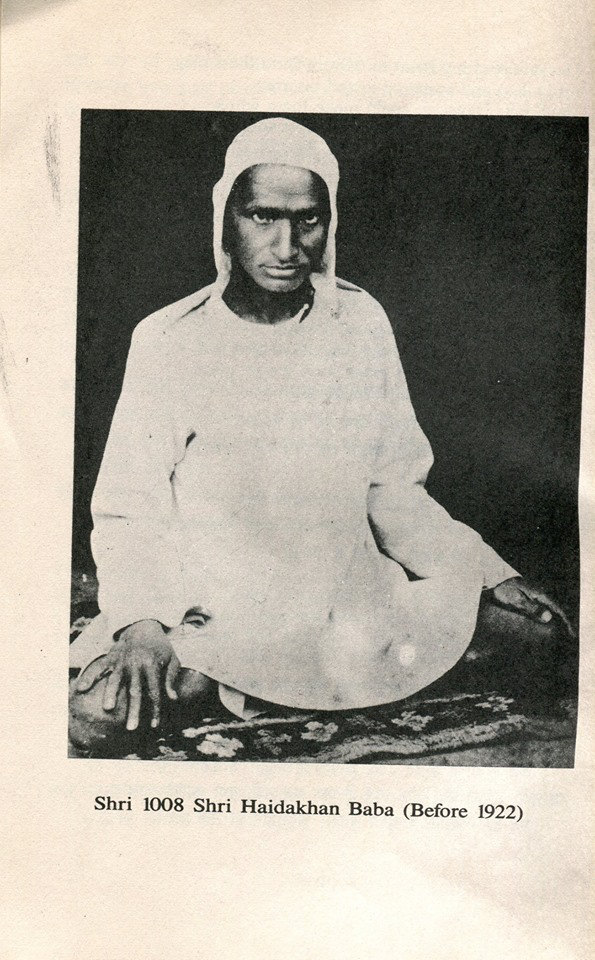
It is all but impossible for men to attain spiritual knowledge, perfection in meditation and the realisation of God — except when God Himself takes a human form. He is born as a living being, in the most ordinary way, exactly as we are. He teaches not by preaching but by training us, and by the example of His own conduct. He incarnates whenever the need arises: to keep the harmony of His creation, to uproot adharma, and to give protection to His devotees. His personified form may remain a single form throughout His līlā, as with Śrī Rāma or Śrī Kṛṣṇa; or it may continue through many forms, as with Lord Śiva incarnate in Śrī Haiḍākhān Bābā. Śrī Bābājī was the eternal manifestation of God in human form. He appeared in the year 1840 in the village of Haiḍākhān, at the foot of Mount Kailāś. Though He moved everywhere, He centred His work above all upon the hills of Kumāon. During the time of His līlā He displayed many mystic powers. He established three āśrams: at Haiḍākhān (Distt. Nainītāl), at Siddhāśram (Almoṛā) and at Kāṭhghariyā (Haldvānī).
Śrī Bābājī disappeared in 1922 at the meeting of the rivers Gorī and Kālī, at Askoṭ, Pithorāgaṛh, in the presence of a few devotees. Though He had gone from public sight, He would often give darśan to His disciples in India and abroad, whether in vision or in physical form. To many devotees He gave darśan in the form of Śrī Mahendra Mahārāj.
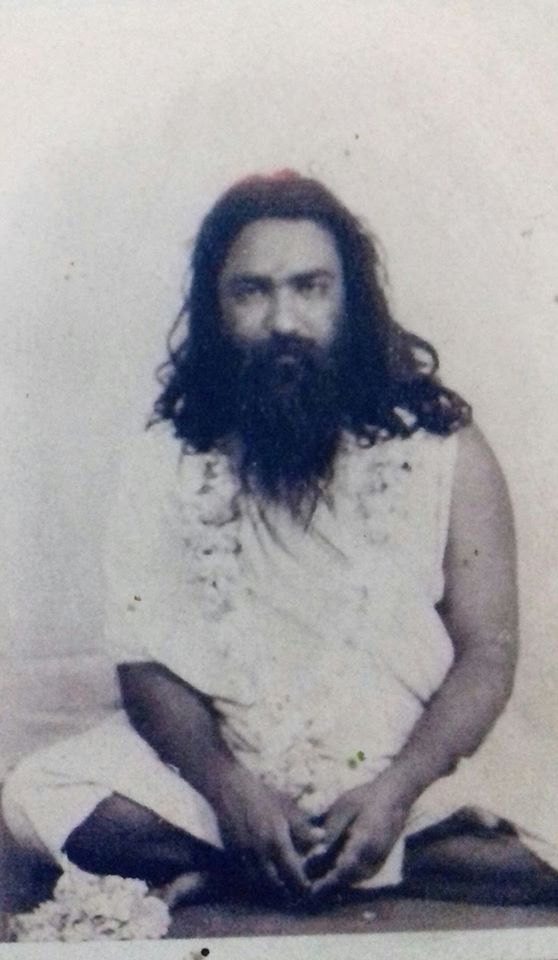
After Śrī Haiḍākhān Bābā disappeared in 1922, a great Siddha yogī became widely known for teaching his disciples about Bābā Haiḍākhān. This was Śrī 108 Mahendra Mahārāj, known also by several other names — Śrī Charaṇāśrit, Śrī Kṛpā-pātra and Brahmachārī Bābā. Though he had acquired high learning and won the highest degrees, he used them to lead so plain a life that no one could have guessed how deeply educated he was.
By divine grace he first made Vṛndāvan and Lohban his dwelling places, and afterwards remained in austere spiritual practice at Lohban for thirty years. He would sit unmoving in one posture for days together, reciting the Durgā Saptaśatī. In those Lohban years several people were brought back to life after they had died; many became learned, and many unlettered men became composers of hymns. Childless couples were blessed with children, and the poor became rich. He never took money for these miracles. He would say, "All this is by the grace of Śrī Munīndra Bhagavān; I am only His humble servant."
Following the instructions of Śrī Haiḍākhān Bābā, he left his home for ever. He came into the company of many saints and Siddhas, yet cared nothing for the winning of mystic powers. He grew so great in influence that kings came seeking him — and he would not so much as touch the food they offered him.
Śrī Haiḍākhān Bābā, whose bond with him ran back through many lives, accepted Śrī Mahendra Mahārāj as His disciple in childhood, like Dhruva, in Bihār. In due time Mahendra Mahārāj travelled the whole of India in search of his Sadguru — Mānsarovar and Kailāś, Nepāl and Tibet. Unable to find Him, he resolved at last to end his life, and with that in mind journeyed from Haldvānī into the Himālaya. Under the name Kṛpā-pātra he set down his experience and his recollections of that Himālayan journey in a book called Bhagavān Śrī Haiḍākhān-vāle Bābā kī Anupam Kṛpā.
Lord Śiva blessed Śrī Mahendra Mahārāj with the making of divine literature and the building of the temples of Bhagavān Haiḍākhān, for the welfare of mankind.
Accordingly he wrote the sacred books Nām Sādhan, Puṇya Smṛti, Anupam Kṛpā, Āśīrvād aur Ādeś, Āvaśyak Karma and Divya Kathāmṛt. A single glance at these holy books gives the merit of ten million yajñas. The temples of Bhagavān Śrī Haiḍākhān Bābā were founded at Kāṭhghariyā (Haldvānī) and at Vṛndāvan. These temples are Siddha Pīṭhs, and they grant the devotees their desires; the sacred books are like the Kalp Taru, the wish-fulfilling tree, which confers hidden powers upon the devout.
Śrī Mahendra Mahārāj did much to reveal to the world that Haiḍākhān Bābā is the incarnation of Lord Śiva. He composed besides the stotras, the stutis and the ārtīs (temple worship) that are used in every temple of Śrī Haiḍākhān Bābā throughout the world. He placed sound material in the hands of the devotees — powerful instruments that will serve the generations still to come, and carry them swiftly toward the goal of the spiritual path.
No other disciple has done so great a body of work as Śrī Mahendra Mahārāj to spread the name and the message of Śrī Haiḍākhān Bābā.
Hardly anywhere in the world can another example be found of such devotion given by a disciple to his Sadguru as Śrī Mahendra Mahārāj gave. Before he took Mahāsamādhi on 23 June 1969, Śrī Mahendra Mahārāj made one prediction of great weight: that Śrī Haiḍākhān Bābā would appear again in 1970, for the welfare and the blessing of every living being in the world. Mahendra Mahārāj took his Mahāsamādhi in 1969. When his body was carried in procession to the cremation, thousands of devotees stood there in mourning for him.
While he lay upon the pyre, his hand was suddenly seen to rise of itself and bless his devotees; many devotees call that event to mind on the same day every year at Vṛndāvan.
Keeping the word of Śrī Mahendra Mahārāj, Brahmasvarūp Śrī 1008 Bhagavān Haiḍākhān Bihārī Dev appeared again in 1970 in the form of Mahāvatār Bābājī, in His compassionate form, to bestow His blessings upon His devotees. The immortal and unborn Mahāvatār Bābājī initiated Śrī Śyāma Charaṇ Lāhirī into Kriyā Yoga in 1861 — as Paramhansa Yogānanda and Śrī Mahendra Mahārāj have each described, in their books Autobiography of a Yogī and Bhagavān Śrī Haiḍākhān-vāle Bābā kī Jagadudhārak Līlā respectively. For Śrī Bābājī there is no relativity of past, present and future. Nowhere else on earth is there a parallel to this: a God incarnate worshipped at one and the same time in His personified moving form and in the motionless forms within the temples. To stand in the physical presence of Śrī Bābājī was the greatest divine experience open to us as human beings. Thousands of people from India and from abroad, from every walk of life, have come to Bābājī. Every one of them has an astonishing story to tell that bears Him out. Since His reappearance, Bābājī performed many yajñas and established His āśrams throughout India. After His public appearance His chief teachings were nām-jap — the chanting, above all, of Om Namaḥ Śivāya — Karma Yoga, and the practice of truth, simplicity and love.
Doubts arose in the minds of some people concerning the immortality of Śrī Bābājī, because of the manner in which He took Mahāsamādhi in February 1984. Every attempt to understand the plays of Śrī Bābājī will be in vain, for they are deep beyond measure and full of secrecy. Śrī Bābājī is immortal, a spiritual master with the power to materialise and dematerialise His Body at will. He can change His physical Body faster than His devotees can change their minds and their feelings toward Him. The first divine manifestation in the "different" eternal forms of Bhagavān Haiḍākhān went from "old" to "young", and from young to a "Bāl Yogī". The immortality of Śrī Bābājī, which has continued from time out of mind, has in no way ended with the Mahāsamādhi. Those who set themselves against the manifestation of any Avatār, knowingly or unknowingly, have had to pay a heavy price. It is impossible to identify God incarnate with the ordinary technical instruments of modern science. Spiritual science begins where physical — that is, material — science comes to its end. We are counselled therefore to keep patience; prayer is the one sure thing left to us for the revealing of the truth.
Śrī Bābājī can be seen or recognised by people only when He so wishes. Gosvāmī Tulsīdās set this out well in the Rāmcharitmānas: "Soi Janai Dehu janai, Janat tumhahi tumhi hoi jai, Tumharihi kṛpā tumhahi Raghunandan, janahin bhagat bhagat ur Chandan." "He, the devotee, knows Thee whom Thou blessest to know Thee; and having known Thee, he becomes as Thou art. Lord Rāma! Thou art as the sandal held in the cool hearts of Thy devotees. Only by Thy blessing can the devotees know Thee."
As for the publication of this sacred book: the typescript was handed to me by Śrī Mahā Prabhujī (Śrī Bābājī) without a word of explanation. All these years it has been kept with me as a treasure. When two of my own books, Saṅkīrtan Sādhan in 1991 and Sukh Śānti Dīpikā in 1992, had been published, I decided to bring out this one also; and by the blessing of His Holy Feet it is now in your hands. The language of the original book was difficult, and the translating was truly a great labour; yet by the grace of Śrī Bābājī it has been well done. Two poems by the translator have also been included in this book for the benefit of the readers.
BHOLE BĀBĀ KĪ JAI
Ever longing for Mahā Prabhujī's divine dust of Holy Feet.
Ever longing for the divine dust of Mahā Prabhujī's Holy Feet.
Mahant Bābā


THE GRACE OF THE GURU
I bow at the sacred lotus feet of the guru, who is an ocean of compassion and the visible form of Viṣṇu Bhagavān. His words are like a thousand rays of the sun, lighting up the darkness of ignorance.
I pay homage to the dust of my guru's feet — the dust in which the lovely essence of every goodness resides. It is full of fragrance too, and sweet to the taste. In the dust of those feet is the savour of that nectar for which the disciple longs. The dust of the guru's lotus feet is ambrosia, and the true Name is the root of that nectar. It quells the round of birth and death. That same dust is like the majestic radiance of the sacred form of Śiva. It gives birth to blessing, pure and auspicious. It can wipe the grime from the mirror of the minds of highly evolved men, and when it is laid upon the forehead it brings the blend of the three guṇas into harmony.
The nails of the guru's feet are like glittering gems, and deep recollection upon them wakens divine insight in the heart at once. Their radiance destroys the darkness of illusion. Fortunate indeed is he whose heart that radiance enters. The moment it enters, the pure inner eyes open, and the sicknesses of birth and death are erased in this life of darkness. When that light shines, all hidden things become visible. As soon as it illumines the heart, every sublime and secret jewel is seen. As a wise devotee who applies the magical and perfected collyrium gains perfection, and can behold the beauty of the mountains, the forests and the earth, so too, when the dust of the guru's feet is applied to the eyes by a wise devotee, he gains wisdom and sees the wonders of these mountains, forests and earth as the play of nature.
The dust of the guru's feet is that fair and delicate collyrium which is nectar to the eyes and has power to heal their diseases. Applying this collyrium to my own eyes, making them bright and strong, I begin to tell the life of the Lord Rāma, by which the fears of worldly existence come to an end.
(Bālkāṇḍ, Rāmcharitmānas)
INTELLECT AND FAITH
The well-ordered diversity of the whole world, and the harmony of its steady working, are proof that an omniscient and effective power governs it. From time immemorial the mind of man has busied itself in many ways to gain knowledge of that power. On this subject the most ancient verse says: "That Supreme Power has been worshipped by the sages under many names and many personifications." Those sages were not content to acknowledge His irresistible power in words alone; they were satisfied only when, having realised it, they found it working in all their senses and organs. They called it the 'Eternal State', the 'Highest State'.
They came to peace only when the Transcendent was realised by their own senses. Out of that realisation in the heart came a ringing inspiration, uttered by them in words: "The Virāṭ, the Giant Form, has thousands of heads, thousands of eyes, thousands of feet (Yajur Veda). It works as the hands, the feet, the head, the mouth and the ears, covering every thing of the universe." The sages of the venerable past who won this long, abiding and joyful realisation were wise men with well-governed faculties; realising without pause that awakened, benign and blissful power, they gained lasting peace as its fruit.
But this realisation did not come easily to all the senses and organs. It remained a thing held by the intellect, arrived at as its conclusion. The brain was fully satisfied, but the heart — the feeling part of us — could win no contentment there. The brain is content with mere academic analysis. We can shut ourselves inside our imagination and live like an emperor in such a world of dreams. That is easy enough for the intellect; but the heart has an ever-present nature of knowing and of meeting — of losing the sense of separateness altogether and merging into the other. That aim was not achieved.
From that time man, urged on by his own nature, tried to establish full union with those essential and practical things which join the transcendent qualities to the heart and its emotions. Neither the heart nor the intellect is rid of its thoughts and its questions until it gains true knowledge and the actual realisation of the inexpressible and undefinable. So the faith of the heart does not count its search complete until it has made God its object of meditation — a God who can be spoken of in one's own tongue and seen with one's own eye.
Knowledge and intellect, though they go by different names, are in fact one and the same. Both have been used with the same meaning. Even in the scriptures it is written: "Though liberation cannot be gained without the intellect, a vision of the Lord may yet be attained through intuition."
In the same way faith and devotion are also one. The scriptures say: "Faith can realise the Truth." Śrī Bhagavān says: "By boundless devotion thou canst reach Me."
There is, then, a deep connection between the intellect and faith. Just as the physical body perishes when it is cut in two, so in the spiritual life, if the intellect is severed from faith or faith from the intellect, spiritual insight is brought to extinction. Not in the spiritual field alone but in every human activity these two powers, these two energies, are needed, working in full harmony with one another. Without their cooperation, without both of them at work, no task can be carried through perfectly. The whole unfolding of the human being — the soul's full realisation, the seeker's attainment of his inspiration, the lover's complete winning of his beloved — is possible only when the intellect and faith work like the Gaṅgā and the Yamunā, flowing together in confluence. For a truly successful life it is absolutely essential that these two currents flow as one. May the flow of these currents in every field of our life be fully coordinated, pure, steady and free — for it is this that carries us to immortality, and in whose presence we move towards the light.
The forces of creation, the intellect and faith, are an indivisible part of the divine energy. For the deliverance of a mankind afflicted by diversity, take it as certain that the Divine Mother, being One, has assumed more than one form, and these two are among them. The power of the Divine Forces may be manifested chiefly as might and grandeur, and also as sweetness. Both belong to the radiance of Śrī Bhagavān, and the compassionate Lord endows His devotees with divine might and with the charm of sweetness. Both are hard for a creature to obtain, for a being still in bondage cannot bear the Divine Power. Only the compassionate Divine Mother, in Her grace, scatters particles of Her divine sweetness in our hearts. That Divine Power, holding Its own Forces in check, descends into the human heart and takes a compassionate, watchful form of divine sweetness. Śrī Bhagavān has said: "I am Dhanañjaya among the Pāṇḍavas. Among the demons I am Prahlād." The feeling of devotion in a man is therefore the very form of the Lord. When a person is sunk in māyā and drifts day after day on the river of his own leanings, by what strength shall he cross this unfathomable māyā? Therefore, as we have accepted the union of intellect and faith, so too are grandeur, might and sweetness complements of one another. The intellect is the ground of all thought of might and grandeur. It never consents to accept anything unless it is defeated. Until the hammer-blow of logic and the cross-examination of its thousand suspicions have crushed those suspicions utterly, it cannot come to a clear and settled conclusion upon the matter before it.
Divine Faith is full of a gentle lustre. In human lives, on the field of struggle and effort, on the troubled waters of the mind — waters made restless by the winds of our leanings — Divine Faith gives us the jewel of bhāva (the heart's steadfast feeling). Having received that steadfastness, bestowed by faith, we come to fulfilment. Leaning upon the pure ray of that jewel, we shall be freed from the darkness of ignorance, from the helplessness bred by the want of divine wealth, from the night that veils knowledge and from the threefold sorrow of the world; and we shall obtain the Divine Light, the divine Splendour of Truth, and benign Blessing.
As the confluence of the Gaṅgā and the Yamunā becomes a place of pilgrimage, the holiest of holy places, so from the perfect union of the intellect and faith an inexpressible divine flame is kindled in the field of our striving. That flame builds our inner life; it takes its throne and settles in our hearts, and we know it as bhāva. The oneness of the devotee, the devotion and the object of devotion — the living energy behind the search — is bhāva; and the person of the devotee, his devotion, and the Lord to whom that devotion is directed, working as one in a trinity, is bhāva. Bhāva is the tangible form of the Lord.
The manifestation of the Lord is possible only through bhāva. I am trying to describe the Revered Lord, who is tangible and yet intangible. The Supreme may stand beyond us, yet He is never a Puruṣa past all experience. His command, His teaching and His blessing were gathered into a single sentence: "As is thy bhāva, so is the clearness of thy vision."
Happiness and suffering, merit and harm, gain and loss, trust and doubt, and birth and death as well — these make up the world. From whatever angle a man looks upon this world and upon the Lord, in just that way do they come to him in realisation. Where there is no bhāvanā, there the Lord cannot be; and whatever else may be called bhāvanā, if the Lord is not in it, it can be nothing but animal appetite. A man who is not in communion with the Lord is no yogi. It is impossible for bhāva to dwell in him. It is true that bhāvanā is gained only by taking refuge at the feet of some great soul, at the lotus feet of the guru. For one who seeks that refuge, even the hard roads to realisation grow easier. This is the rule of the Lord. "O Arjuna! For those who behold themselves in Me, I am the deliverer from the ocean of this mortal world."
Those fortunate ones who consciously give themselves wholly to those divine feet, they alone will reach salvation. They will have the vision of the Lord in all His beauty.
THE UNSOUGHT CALL
In the midst of that emotional turmoil the Lord took only my restless heart, and in its place gave me shining feelings of devotion and self-surrender. As a lowly ant catches one breath of the fragrance of honey and follows it until it reaches the comb, so this enchanted mind of mine — caught in a throng of thoughts and counter-thoughts — was roused by an unquenchable longing to meet the Lord, the giver of devotion and of the heart's deep feeling. By many means I tried to soothe that restlessness, but in vain. Indeed, the harder I laboured to free myself of the affliction, the worse it grew. This went on for several years. I had little faith in spiritual disciplines. If I took a step in that direction the very idea repelled me, for I felt that their final end was the winning and the enjoying of some cherished object. Even if such exercises should overcome every obstacle, I thought, the result would after all be the attainment of the siddhis (occult powers). But that could not give me so much as a taste of the Lord, and without Him I would never find lasting peace. He would take no pleasure in my mere gaining of siddhis; such disciplines, then, could serve me nothing. Thoughts of this kind weakened whatever wish I had to practise them. If at times, for all my indifference to worldly things, I felt myself attached to this world of appearances, that attachment was given little chance to harden into any settled shape. In the course of these disciplines I met many princes, was offered riches, and was given respect in abundance. Knowing well that I sought nothing except God, I found the heaping up of such things useless and painful, and I left them behind without regret. By worldly reckoning I gained many priceless possessions; but by the mercy of the Lord every one of them appeared to me unworthy. In those days it was often said, during the religious discourses, that a struggle was going on between myself and māyā (illusion).
Sometimes māyā gained the upper hand over me, and sometimes I overcame her. Māyā was helped by her Lord, and I by my Gurudev. If the Lord came to māyā's aid, I would pray to Śrī Mahārāj, my guru, the helper of the fallen, and he would surely grant me the victory. How long could I go on drawing out the tale of this war between demons and gods, waged in the shape of thoughts and counter-thoughts, doubts and truths? Three or four yugas would not suffice for the telling. Yet it was a battle fought in every moment of my life. From one instant to the next these forces gave rise to clashes like those of the epic Mahābhārata. No artist can grasp that state of my mind. No philosopher can define it. Only if others stricken with the same malady were to meet one another might they gain some faint notion of it. The conflict went on for years, by night and by day. It would be no exaggeration to say that it went on in every breath I drew, in one form or another; and when its whole course was turned about, my mental agitation, I must say, reached its very summit. Courage and dread took possession of my heart as of a battlefield, to a degree beyond my power to describe. At last I came to this conclusion: I would follow no other purpose in life, but would give my time and my strength to the attainment of the Lord alone. By the attainment of the Lord I meant that no thought save the thought of the Divine should rise in my heart. If by chance, waking or sleeping, I were to catch some taste of Him, that would not mean to me His full Presence, His darśan.
This I resolved many times over, and still I could not surrender my love of life. I became rapt, longing to meet the Beloved, and I cried out in reproach, "O mind! How long will you go on making excuses? Now you must do what you have decided. Now there must be no delay in coming to a decision. Decision and success are bound together." I do not possess a strong will, yet by the grace of God I became resolute even so. Ah, that day! It was the fourth day of the bright fortnight of the lunar month, in Saṁvat 2006, the year 1949. It was a Tuesday, and of great auspiciousness. From the first light of morning I was alight with inspiration, with faith and with boundless joy. This was the crown and the happiness of all my former lives, when the Lord, the Saviour of the oppressed, was calling me under His protection!
It was a love close to frenzy. I took the firm decision to leave my home that very day. I spoke of the decision to no one; I told my friends and my benefactors only that I was going up into the hills on pilgrimage. My friends tried to delay my departure, since by astrological reckoning it was not an auspicious day for setting out. The matter was laid before the priest of the temple of Mother Durgā. In the gladdest of voices the venerable priest said, "Where is the need to seek an auspicious hour for a devotee like you? For such a one every hour is auspicious." Hearing this from the priest, and light of heart, I made obeisance to the Mother Goddess and to the devotees; and at that very hour, at half past ten, I took the bus for Almoṛā, in the hills of Kumāon.
The famous Pātāl Devī temple at Almoṛā is very ancient. From of old, many great saints and yogis have made it their dwelling place, as the great number of their carved images bears witness. Streams are plentiful, both nearby and within the town. This holy place is therefore of great convenience to those who wish to practise austerity. It pleased me too; but after living there three or four days, the same question rose again in my mind. The unhappiness that had driven me into the Himālaya was with me still, the goal was still unreached, and the same daily round of worldly business — eating, drinking, sleeping, talking — went on as before.
For a seeker, to stay long in a place merely because it proves comfortable is itself an obstacle; so I left Almoṛā and set out on foot for Kosī. This place, on the bank of the river Kosī, is where every vehicle comes to a halt. It has a few shops, and the road runs down to Almoṛā for five or six miles. I asked an old shopkeeper to direct me to some solitary spot where I might stay. He told me of the Sun temple, and related to me a number of tales of its greatness.
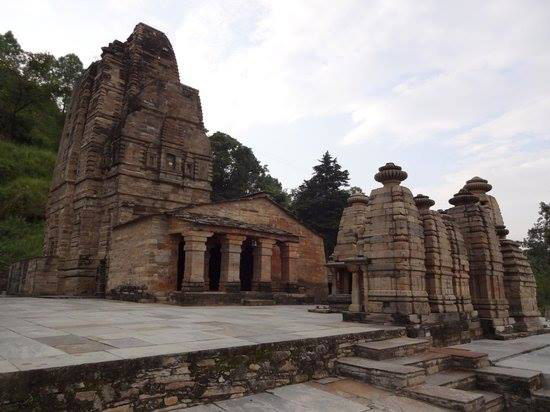
The temple stands conveniently placed, a mile from Kosī. The road climbs the whole way, and the village is called Katarmal. I stayed the night at Kosī and went up to the Sun temple early the next morning. It is a most beautiful temple. Because of its high situation one can see a number of tall peaks all around. A stream runs close by, and the villagers use its water. I met a number of men, women and children from the neighbouring village. They pressed me to accept food from them, but I declined their offer; for I felt that this was the place I had been seeking, the right spot at which to begin my fast. I was filled with peace. I had no anxiety for the past or for the future. Even the thought of the Lord was not uppermost. Beneath that calm a very intense emotion was at work, which I am unable to describe.
Absent too were the disturbances of a devotee's experience, the eight kinds of agitation that are visible in those absorbed in the study of the scriptures. The peace and the everlasting blessedness that shine out in saints attuned to the unmanifest Almighty — that also was absent.
Nor was there any sign of the striving that seekers make for the attainment of superhuman powers, or for the fulfilment of those desires that are pursued in humility and helplessness. Indeed, thinking upon it deeply, it is clear to me today that this wonderful opportunity was nothing but an unasked-for call from the Lord of the Universe, who labours for the world's renewal. Just as a restless mind drowns in its own distractions and has very little to do with the world outside, so I too was drifting here and there, a traveller sunk in the thoughts of his own mind. As my mind grew ever more troubled and ever more indifferent to life, the merciful Lord, who cares for the weak, was eager to set me travelling upon the road of enlightenment. His supreme love and compassion are His great gift to us, by which He bestows light and self-sufficiency upon bewildered humanity. For people such as ourselves, the compassionate nature of the Almighty is everything. The compassion of Lord Śiva gives a sure and mighty ground to His devoted disciples.
TOWARDS SIDDHĀŚRAM
To save myself from the sunlight, and from the eyes of the people outside, I went into the temple. For a long time it had not been swept or dusted. That most artistic temple stood in a state of deep neglect; even the daily ceremonial worship and its rituals had ceased to be performed there. Yet its peace and its coolness impressed me greatly. Very soon my mind let go of every outward answer and grew happy in inward contemplation. At that moment a hill-man came in. He seemed an ordinary villager of about twenty-four or twenty-five, on his way to the shop to buy some household necessity. The road to the shop ran at some distance behind the temple. The man was astonished at himself for having entered the temple with no intention whatever of doing so. The moment he stepped in, my mind too leapt toward him, and I went on gazing at him. Without so much as bowing to the Deity, he began to say to me in a loud voice: "Come out — what sort of man are you? The temple is full of a foul smell! I cannot bear it even this long, and you have been sitting here all this time. This is not good, and your health will suffer!" When I heard this I became aware of the bad smell, and found it impossible to stay there a moment longer. Not inside the temple alone but outside it, all around it for some distance, the smell had spread for several days; the people of the village had stopped using that road and went round another way to fetch their water. I too left the place, and sat down a little way off. An extraordinary feeling of delight rose in my heart, and I lay down upon the rocks. I did not realize that my new acquaintance had followed me. Naturally my eyes closed, and I began to turn my thoughts over in memory. When after some time I opened my eyes again, I found the man I had seen in the temple watching me steadily, with a kind of wonder. Greeting me, he said in surprise: "Mahārāj, I was going to the shop on urgent work, and to avoid delay I came up from the village by the direct path, somehow, by steep climbs, instead of by the road. Leaving my own way, why did I enter the temple? We generally pass by here, but I never once had any wish to go in and pay my respects to the Deities." I said: "It is true. If the people of this place had faith, they would never have let so beautiful a temple fall into such a condition." Passing over my remark, he said: "Mahārāj, I shall be back soon from the shop; then you can come with me, and I will take you to a beautiful temple." This was the very thing I wanted. I asked him at once: "What is that place like?" He told me much about its greatness, and said that it was called Śatrudra. When I asked him about its water supply, he laughed and said: "Mahārāj, do not ask about that — such water is not to be had for a long way around. That place is the Kāśī of our hills, renowned for the holiness of its water. There were a hundred thousand Śivaliṅgas there; some are standing yet, and some have been turned up by the villagers while ploughing their fields. Many temples, with the emblems of Śiva in their plinths, lie buried beneath the earth." Hearing this, a great longing rose in me to see the place. Eagerly I asked him: "Can I reach it?" "That is not difficult," he said, "but I will go with you and carry your kamaṇḍal (the ascetic's water bowl). I shall have your company for some distance, and I like you." Saying this quickly, he added, "The shop is about a mile from here; I shall be there in two hours at the most, and then I will come running back." It must have been about nine o'clock. The waiting made me restless, and little by little it began to grow cold. I made no use of fire, and I began to feel hunger and thirst. At last I thought that the time I had allowed the man was long past, and that there would be no wrong in going on. I was deeply grateful to him for that beautiful place. When the night had passed I would certainly go to see Śatrudra early in the morning. Just as I rose with these thoughts in my mind, the man spoke from behind me, tears in his eyes and his hands joined: "Mahārāj, forgive me, I was detained. I have not eaten either, and you too seem hungry to me. Come to my house; we shall both have something to eat, and we will cook whatever you wish." I said to him affectionately: "Brother, show me Śatrudra; I shall go nowhere else. Why should we mendicants go to anyone's house? If there is no such place as Śatrudra, tell me frankly, and I shall not mind." Without a word he took the vessel from my hand and began to walk. I followed him. The road was very dangerous. Its width can hardly have been more than a foot, and it was covered over with loose stones and grass. A moment's inattention would have cost a man his life; one small slip of the foot and he could fall thousands of feet and die. Tired as I was, whenever I asked him how far it still was, he repeated the same words: "Only a little way." The Sun-god too, who had sent me into that temple, having finished his day's pilgrimage, went behind Astāchal (a mythological mountain in the west, behind which the sun is supposed to set) to rest. Out of fear of the darkness, and because of that man's pace, I too walked as I had never walked before. Night came down swiftly as we went. In the daylight we could see snakes and other small creatures, but now, in the dark, we could see nothing. So these unseen and venomous creatures passed over my feet, and it was perilous. In an indescribable state, in that unknown fashion, the man with my vessel in his hand was in truth carrying upon his shoulders the fruits of the saṃskāras (the influence of past births) of my countless lives, and leading me toward Śrī Bhagavān. Ah! And I had not even bowed to him with respect! It must have been about nine in the evening when he suddenly stopped and said: "My house is two miles from here, and my child is ill. Your destination is not far, and you can go on by this road if you wish. If you want me to take you there, think of my return — I shall have to walk four miles, my son is very ill, and there is no one else at home." His words gladdened me. Fearing he might think I had grown weary of him, I said to him affectionately: "You have made me deeply grateful. You showed me the temple of Bhagavān Śaṅkar, and you have guided me to this place as well; I shall go on by this road. My life is one with wandering — go home and look after your son." The man set off. The night was dark, and darker still under the trees and bushes; I did not see him go, and I did not know where or when he turned away. Yet this much I felt: the moment he left, a weight seemed to lift from my head, and I felt light. I was inclined to sit down and rest, but there was no place for me to sit. On a dark night, at a height of some ten thousand feet, I had to walk along a track just wide enough to set my feet upon, with only faith, or my Bhagavān, to help me. I could have sat down even on that narrow track, but there was danger of slipping — on the grass in some places, on the stones in others. So, apart from slackening my pace, there was no other way of resting. After walking fast for an hour and a half or two, I began to grow impatient; but believe me, the high mountains rose before me like reminders of great courage. On so long a road I could find no place to stretch my legs and sit. In my mind at that hour there was no imagining, but a mind acting as the representative of divine knowledge — a peculiar state in which no conflict of any kind arises, like a contented friend questioning his companion, in whom the question would rise of how long I had been walking. The rustle of passing snakes could be heard, and the cries of wild animals. Both fear and courage crossed my mind because of them, and it wavered a little. The intellect was helpless, pride was false, the vital forces were still, the organs of sense were quiet. There was no conflict, earthly or spiritual; having everything, there was nothing. It is impossible to describe in words, or to write down, a ten-millionth part of that particular state of my mind at that moment. Life lives upon hope. The deity of hope was giving me strength. Walking on, I saw a faint light. I thought there must surely be a village there — but how was I to get down to it? Between me and the village lay the river. I thought there was little water in it, yet in the dark it looked dangerous to me. On the far side there was light; on this side rose high mountain peaks. On trembling feet, tired, weak and hurt, I walked along its bank. After a short distance I found a narrow path, and after a long time, sitting down now and then, I reached the river. There was very little water in it, but the water was icy, and there were many great stones. All kinds of insects made all kinds of noises and moved here and there — now crossing the path, now passing between my feet and touching them — roaming unchecked in the darkness of the night. A traveller whose good or evil fortune not even the thousands of mouths of Śeṣ Nāg (the mythological serpent with thousands of mouths) could narrate was passing along that difficult road, under an indefinable impulse, in a state of contemplation. Thanks be to Thee, O merciful God, that when Thou callest, no difficulty can stop a man! After crossing the river somehow, I heard the fierce barking of dogs. Now my mind grew perplexed and bewildered, and the question rose in me: "Mother Nature, is my life to end at the teeth of these fierce dogs?" Then I laughed at myself. It seemed as though I were playing with the Divine. Now and then I would ask myself, "Friend, are you afraid of death? After all, this is a test you are passing through." I stood where I was and called aloud. I began to repeat Hari Har, Sītā Rām, Nārāyaṇ and other names of God. Just then it happened that the women of the village, having finished their household work, had come out at midnight for some special purpose. Perhaps they were keeping some festival. In the Himālaya the people welcome the coming of summer warmly. They went home and told their families that some ascetic was calling out, and that he had not come into the village for fear of the dogs. It must have been past midnight.
A man came up to me with a lantern and said with real concern: "You look very tired. Come to my house now, eat and rest, and in the morning I will take you to Śatrudra." But how could I rest? Panting, I said: "Brother, if it is no great trouble, take me to Śatrudra now." He understood, and walked with me, carrying his lantern before us. Walking in that light I grew calmer. In the darkness my feet had been pierced by thorns and were bleeding, and I had stumbled again and again on the stones; but none of it troubled me. At the sight of Śatrudra I forgot everything, and felt eased of the hardships of the road. The villager and I entered the temple of Śrī Śiva Bholānāth, repeating "Har Har Mahādev."
ŚATRUDRA
Śatrudra is a very ancient place. It lies near Śyāhī Devī in the Almoṛā district, and in that old country it is held in great veneration. There are some ten or twelve small temples, and thirty or forty Śivaliṅgas standing with no temple over them. There are also many finely carved images of Devīs and Devas — goddesses and gods. Besides these there is a rest house, and a small stream that runs beneath a bāñj (oak) tree. A little way off lies a pond where travellers perform their ablutions, so its water looks rather dirty. The water of the stream is very sweet. The moment I drank, all hunger and thirst vanished. By the lantern's light I filled my water vessel. As the night grew late I let the villager go home. After drinking a little more water and making my obeisance, I lay down to sleep in the temple veranda. Sleep came quickly; I do not know how long I slept, but before long the temple's Brahmin priest came to me in great agitation, repeating the name of Śiva, and asked: "Mahārāj, tell me at once what food I should bring you. Tell me quickly — for Lord Śiva Himself has sternly commanded me that an ascetic is hungry and that I must feed him. Even now my heart is pounding!" I had no appetite for food, but to calm the priest I said: "It is late in the night. I will eat whatever you have; but if you take the trouble to fetch food for me from the village, I shall not accept it." With a great deal of hesitation the priest said, "There is nothing here" — and then he began to weep, and said in a choked voice: "Mahārāj, whether you eat or not, I must obey the order of my Bhagavān Śrī Śaṅkar." I was astonished at the way he saw it. I was heavy with sleep and my whole body ached, my feet most of all; and here was this devotee of Śiva adding to my distress with his weeping. Sitting up, I said inwardly to Bhagavān Sadāśiv: "Wilt Thou not let me rest in peace anywhere?" No sooner had the thought crossed my mind than the priest said: "Mahārāj, you look very tired; go to sleep." Just as I was settling down, the priest went into the temple and stumbled against a bundle. Feeling for it in the dark, he found his hand full of flour! He danced for joy. A fire was lit at once with split wood; he baked bread without a tavā (the iron plate on which Indian bread is cooked) and cooked a leaf vegetable gathered around the temple. While he was cooking I told him that the amount of food he was making would be enough for several people, but he was firm that whatever Bhagavān had sent must be used. The food was ready, and because of the late hour of the night it was offered to Śrī Bhagavān only in the mind; afterwards I ate alone. Never in my life had I walked as I had walked that day, and so I ate as I had never eaten before. The food was not only tasty but beautiful. Having eaten, I went to sleep in an open space near the temple, but the priest, being afraid of tigers, slept in the closed room of the rest house. He told me frightening tales, yet at that moment I was full of ecstasy, and little by little I fell asleep and dreamed beautiful dreams. Early in the morning many devout pilgrims gathered there. At this centre of pilgrimage it is held auspicious to bathe and recite the name of God, or to have the priests do it, and also to have the sacred scriptures recited and to offer the bath to the Deities. The priest and some learned Brahmins made me stay on. After the food and the offerings from the temple, I left in the afternoon. Beautiful though the place was, it did not suit me. So, having stayed the night, I went on my way. When I had walked about two miles ahead, I looked back. A deep and swiftly running river had to be crossed by a narrow log laid across it. The local people used it too and had no fear of crossing such a river, but in places like this my feet would begin to tremble. I had known many such trials during my pilgrimage to Kailāś. As I looked back in fear and expectation, I saw that same priest with a smile on his face — the one I had left in the Śiva temple at Śatrudra. He said very affectionately that he had not felt happy since I went away, and that he would stay and serve me for a while. I tried hard to persuade him against it, but he would not listen to me. He came forward, took the bucket and some clothes from my hands at once, and said joyfully: "Follow me, and I will lead you on, hand in hand." With nothing to carry, my hands were free, and on trembling feet I crossed behind him. We were passing through dense forest, and had to face danger at every step. We came upon a great banyan tree, where we rested a while; then, after drinking some water, we went on our way. On the road we spoke of the Himālaya, and above all of the saints who live there. I asked the priest his name, and he told me it was Rādhey. The name delighted me, and as long as he stayed with me I called him by that holy name. "Rādhey, where is the nearest place I can catch a bus?" I asked. "I am very tired and find it hard to walk, so now I shall go towards Śrī Badrīnārāyaṇ." He told me the way to the Śītalākhet motor road; the road was there, but there was no bus service — only private cars and trucks passed along it.
Hearing this from Rādhey, I thought I would go on to Śītalākhet at once and take a bus from there to Haridvār by way of Haldvānī. In a single moment my earlier plans were changed. This is why I so often tell my companions that the will of the holy and compassionate Lord was bound to show itself. In this modern world of unbelief and wholly materialistic achievement — even where the manifestation may take the form of destruction — this strange, peerless and seemingly impossible happening was set forth to grant a vision of all His power, His glory, His blessedness.
I explained to Rādhey: "I am going to Śītalākhet now, and you must return home; I shall not stay long in this place." Pointing with his finger to six or seven white houses in the distance, he told me that Śītalākhet was about four miles away. I began to walk in that direction, but Rādhey was very sad at my going, so I sat down to comfort him.
We were speaking of religious matters when suddenly, with folded hands, he said: "Mahārāj, on the summit of this mountain there is a temple of Śyāhī Mātā, very holy and very ancient; you must visit it. It is long since I went there, and today we could both go and pay our respects to the Deities." My mind was far from visiting temples, or offering prayers, or seeking the company of good men — far, in truth, from everything. One thought alone drove me: to gain the vision of the Almighty Lord in His fullness and to be absorbed in Him. So I said to him with great indifference: "We are always visiting shrines — why climb all that way? I feel weak." Hearing this, Rādhey began to laugh; for these last ten days I had paid no heed to my body, and yet by God's grace no one could tell it — and that was why he laughed. "You are a strong ascetic, and you will have no difficulty in climbing." Saying this, he kept silence. I took his insistence for the grace of the Divine, and quickly began to follow him up to the place. The path was very steep, yet I climbed it swiftly and easily in a short time. I felt like a child sitting and smiling in its mother's lap, carried along by her. This is no exaggeration, but a true realisation of Her grace.
ŚRĪ ŚYĀHĪ DEVĪ
Śyāhī Devī (Śyāmā Devī) is an ancient and celebrated place of pilgrimage, where the worship of Bhagavatī (the Goddess) is performed according to the Tantric system. The great temple stands at a height of nine thousand feet, right upon the summit of the mountain, and it had fallen into ruin. On the summit there is also a pond. It seems to hold very little water, yet even in the fiercest heat, when great numbers of people draw upon it, the water never seems to lessen. Several kinds of grain grow there as well. The climate was bitterly cold, and I felt quite at peace in that place. At night, at the priest's insistence, I took my meal. He left a good store of firewood for my use and said with great earnestness: "If you sleep in the open, light the fire; besides the cold it will protect you from the tigers. If our cattle are left outside at night by mistake, it is unlikely they will be alive by morning." Having explained this to me he set off for his house, and I too, after some time, went contented to sleep.
Not for a long while had I known such sleep — the sleep of one who rests untroubled in the lap of the Mother. Early the next morning, after bathing, I paid homage to the Deity of the temple, and when I had taken my meal I sat in the sun upon a slab of stone. Through my mind ran the verses of Durgā, a path well known to my heart. At that moment a man arrived who was reciting the Sanskrit prayers to the Divine Mother with great devotion.
He bathed, prayed and made offerings of food to the Deities, and he gave a portion of it to me as well. Soon afterwards the pandit and I fell to speaking of religious matters.
At about twelve noon this Brahmin said: "I am leaving this place now — what are your own plans?" I too had it in mind to depart. Here also the priests had shown me their affection. I remained in that place while the people brought me milk, curd, tea, sweets and much besides. Though I begged them not to, they built a great and beautiful sacred fire. I told the Brahmin pandit that I wished to go to Śrī Badrīnārāyaṇ, but that no buses were to be had from there. He seemed a man of wide learning, and I asked him to direct me to the path that led to that place.
Introducing himself, he told me that he was a teacher, and that he would draw a map by whose guidance I might reach Haldvānī without further enquiry. "On the way you will pass Dronagiri, where there is also the temple of Devī Mātā," he said. Dronāchal is mentioned in the Rāmāyaṇ, and so I felt a desire to visit it too. I asked Rādhey to return to his home, and at about two in the afternoon, having paid homage to the Deity Śyāmā, I left the place. That teacher walked with me as far as Śītalākhet, carrying my bucket and my clothes. From here the road descends for three miles to Śītalākhet.
What can be said of the natural beauty of the Himālaya? Such places wear a beauty that never fades, yet my mind was filled with the Lord Śiva — Satyam, Śivam, Sundaram, the True, the Auspicious, the Beautiful. It was not drawn by the fleeting loveliness of the place. Within my mind I prayed to the Divine Mother: "Mother, there are so many trees in this world, and no place of shelter for me!" So, pleading and quarrelling with my Mother — the Divine — and sometimes laughing at myself, I reached Śītalākhet.
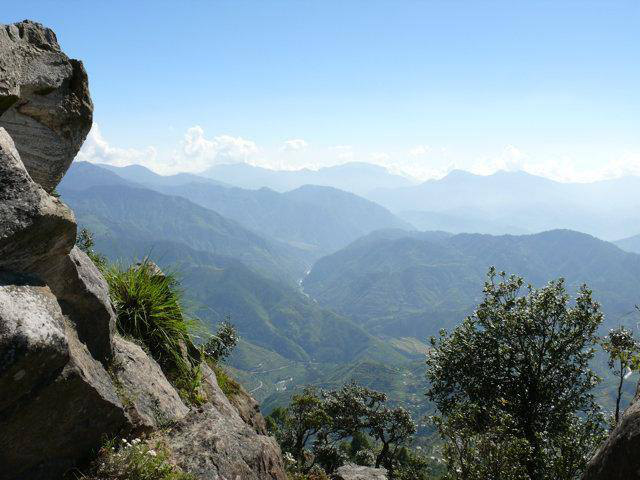
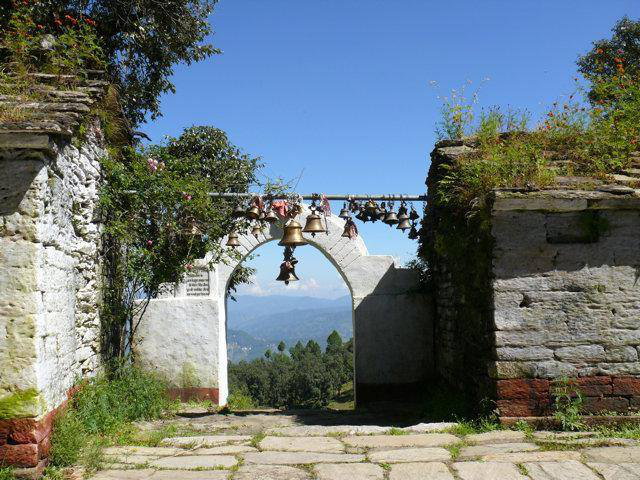
ŚĪTALĀKHET
There are ten or fifteen shops there, and a centre of the All India Scouts Association, which has raised a memorial building. An elderly and well-known gentleman named Śiromaṇi Pāṭhak lives here. I am deeply grateful to that noble soul — not only because he told me of Siddhāśram, but because he insisted that I go and see it. The moment he saw me coming he rose from his chair and cried out "Father!" in great agitation, as though he had met, all unlooked for, a dear one long absent from him. He seated me in his own chair and pressed sweet fruit upon me from his garden — apples, pears, apricots and the like. It was nearly sunset. I said to him gently, "I shall be going now," but he seemed not to have heard me at all. To the schoolmaster who had walked with me Śiromaṇijī said sternly: "You may go if you wish. How can a man be the companion of a saint? Bābā, you will stay here today." The teacher remained a little while and then left, and I began to talk with the emotional old man. I liked the place. We sat outside on the veranda of the two-storeyed building, and before us rose a high mountain, made lovelier still by the snow that clothed its summit. Śiromaṇijī used to call Him by the name Bhagavān. His own nature was a singular one: in his moments of ecstasy he would weep, laugh and dance, and at such times he had no notion of time or of place. The sun had gone down, and after our meal we sat together, Śiromaṇijī a little distance from me with his hookah. After a few draws upon it he said, smiling faintly, "Do you know what this place is, where you are sitting?" I did not understand, and he explained: "The first time — the very first time — that Bhagavān Śrī Haiḍākhāṇḍī came into these parts, this was the spot where He set His lotus feet." Saying it, he passed into a state of ecstasy. I said to myself that here was a devotee of ascetics and saints; and if he showed such respect and reverence even to a man like me, it was no wonder that his feeling for the great sages of the Himālaya should be so overwhelming. A great many of these Great Ones dwell in these hills, so his immense devotion to them was hardly to be marvelled at. With such thoughts running through my mind I gave little heed to his words; but when I turned my attention back to him, he was saying: "He is Bhagavān Himself in human form. I am an unlettered man, yet the verses I have recited come from the grace of that Great Being. I was born into a poor Brahmin family and kept a small stall in a hut of thatch; but today at Śītalākhet I have many orchards, shops and buildings. All of it I owe to the grace of that Great Being. What more can I tell you? It was through Him, too, that I was granted the sight of Bhagavān." Hearing this, I too grew eager concerning the manifestation of Śrī Bhagavān, and asked Śiromaṇijī affectionately to tell me something more about Him. At the request he broke into weeping; then, in a voice choked with sobs, he began to speak, but he was so overcome that it was long before he recovered his natural composure. Once again I pressed my impatience upon him. From the agitation of his mind I felt convinced that whatever he was about to tell me of that Great Being was truly what he had seen with his own eyes. Then Śiromaṇijī began, singing in a melodious voice verses of his own composing, whose burden was this: "O Bābā, Thou hast left us. I am alone among these creatures of the Kaliyuga." Hearing words so full of feeling from him, I too was moved and shaken for a moment. It is said that only one who has been parted from his beloved can understand — or another in the same state of heart; and that was exactly what was happening there. In that inspired moment, in the silence of the night, we were both borne up on a beautiful wave of feeling. Śiromaṇijī looked at me and let out a forced laugh, so that I laughed with him. Then, after we had sat silent a while, he began to relate the beautiful happenings concerning Śrī Bhagavān Haiḍākhān Bābā. I asked how he had been blessed with the vision of Śrī Bhagavān, and at the question he began to weep again. I tried to calm him, saying that these Great Beings are present everywhere, and are with us even today. I begged him to tell me the story of His Sacred Self, for I was impatient to hear of Him. Śiromaṇijī began his account in this way: "An hour before my uncle died he said, 'Only see how merciful He is! Śrī Bābā has come here to save me. Give Him something to sit upon. Worship Him!' Those standing about him thought he was raving; but in truth Śrī Sadāśiv was granting him liberation, revealing Himself to him in His glorious form." From that moment, Śiromaṇijī said, he too felt a great longing to obtain the vision of Him. The longing grew overpowering — but how was he to meet Him? He had heard tales of His beautiful appearance, yet until then he had never been blessed with the sight of His form. Then one day, without warning, two hundred to two hundred and fifty men came to his house, and with them were two or four palanquins. In their midst was a great and merciful Sage: beautiful beyond telling, ringed about with ceremony by many wealthy and respectful men who stood with folded hands. He wore a shirt and a headcloth, a lovely smile was upon His face, and His silent grace lay on everything around Him, living and lifeless alike. At that time Śiromaṇijī was suffering from a badly festering wound. The instant he heard of Śrī Bhagavān's arrival he ran towards Him in joy. He slipped on the wooden stair, a splinter of wood pierced his foot, and he fell and fainted away. Those around him were anxious for him; but Śiromaṇijī was lying with his head resting upon the merciful lap of the Lord, in a trance beside which even the trance of the great Brahmarṣis would seem faint, tasting a peace like nectar, wholly fulfilled. After resting there some few hours, Śrī Mahārāj set out to go forward again with all His faithful, whose number had swelled into thousands in a very short time. He kept no fixed programme. Wherever He went, with no effort and no summons, thousands of men and women gathered. When word of His coming spread, scarcely anyone would stay at home. There were neither questions nor answers; people knew peace at the mere sight of His presence. Learned scholars of Sanskrit, ministers, social reformers, labourers, rājās and nawābs all came to see Him. In the presence of this Great One, who is the guide to the final goal of all teaching, the problems of self-realization, the ways and practices of mutual discourse, and the road by which stillness leads to the realization of Brahman lay open to everyone in equal measure. A gentle face always, compassionate eyes, a kindly bearing, a slender body, the gestures of a child, a shirt and a headcloth for clothing — these features of His were the source of a supernatural attraction for all. Of food He took very little grain; buttermilk He drank in plenty. Śiromaṇijī told me that during Māgh — the eleventh month of the Hindu year — in a hard winter when the snow fell here to a depth of three feet, he had to go from house to house begging buttermilk for Śrī Mahārāj, who used to drink it as other men drink water. Everything He left behind Him carried a supernatural fragrance, and would dissolve away within an hour or two. When He opened His palms, the company of devotees around Him were left intoxicated by their divine perfume. His hair did not grow. He never slept. Śiromaṇijī lived with Him for six months and never once saw Him asleep. Besides the postures of yoga He would sometimes take the Mukhāsan posture as well. If someone covered Him, He allowed Himself to be covered, but He never asked for clothes; and though clothes were there, He never used them. His devotees came before Him with costly garments, gold coins and many precious things, yet He would not so much as look at these worldly goods. Yes — to entertain His devotees He would sometimes play with such things like a child for ten or fifteen minutes; after that anything might become of them, and whoever wished might carry them away. He made no arrangement whatever for their disposal. To Him dust and treasure were all one. Friend and enemy, slanderer and admirer, sinner and saint — in His compassionate gaze all alike had every claim upon His mercy. Śiromaṇijī told me great, wonderful and unheard-of stories of His supernatural deeds, seen by his own eyes. Being of a doubting nature, I sometimes marvelled at his tales; and then he would swear on his faith, on himself, on his son, on everything he had, that whatever he told me was perfectly true. Little faith as my heart held at that time, I was compelled to believe these supernatural happenings. We talked together for hours. It came to me then that I had no inclination for prayer, for the repetition of sacred verses, or for discourse upon religious subjects — and yet how absorbing I found this talk! It drew me powerfully. The whole burden of Śiromaṇijī's words was this: Śrī Haiḍākhān Bābā was God Himself! This embodiment of God was extraordinary! As the six fortunes dwell by their nature in the Lord, so they dwelt, miraculously, in the glorious body of this all-powerful Saint. He had seen many cases with his own eyes: the dead brought back to life; the unlettered given, in an instant, the eloquence to compose; the childless given children; those ruined in their fortunes given immense wealth. Devotees seeking divine qualities had all their desires fulfilled and gained power over hidden things. Those of us afflicted by the threefold sorrows — ādhyātmik, ādhidaivik and ādhibhautik — obtained eternal peace. Seekers of salvation, and not Indians only but people from Europe and holy men from Tibet, took refuge under His brave and generous protection and attained realization. People of differing views and religions, and great devotees too, came to the feet of Śrī Bābājī and had their longings satisfied. Śiromaṇijī's good company, long or short, and his talk, were the confirmation of it. Again and again, deeply shaken, he swore upon oath to these wonders. It was far into the night when we went upstairs to sleep, and I too, after praying to my Guru, lay down; but until sleep took me my thoughts would not be still. There are many kinds of sacred Beings in this world — the Divine Mother, Īśvara. May a deep knowledge of their essence dwell in my memory without ceasing! May I remain, by day and by night, happy in my beloved Lord. Surely this great Sage was God Himself. In the Rāmāyaṇ and the Mahābhārat there are descriptions of such supernatural things. In these days, in this world, such mighty and great personalities are neither seen nor heard of.
Could it be He? Is He my beloved Lord? It was a great favour of the Lord that I should meet a man who had tasted the nectar of God's touch and had pressed His feet with his own hands. Ah, how many different things had befallen me in my life — now sorrow, now happiness. It was the eleventh day since I had left Haldvānī, and yet an experience so divine, so clear-seeing, so beautiful had rarely been granted me — not in that pilgrimage alone, but perhaps in my whole life. Joining my hands in reverence, I paid homage to Śrī Bābājī again and again. At first, in the silence of the night, I offered that homage inwardly; but it did not satisfy me. So I rose and bowed down before Him with reverence, and I was glad that Śrī Bhagavān had accepted my obeisance. Within my heart a resounding voice was heard, confirming the faith that He was in truth Śrī Bhagavān. Such power and such compassion are possible only in an Avatār (God incarnate). Oh, how simple was His daily life! Though He was so great, He hid His greatness utterly, and, brimming with mercy, poured His own divine lustre into ordinary human beings. With such thoughts in my mind I fell asleep. In the morning Śiromaṇijī came to me, and sent milk for me as well. We began once more to speak of Śrī Mahārāj. That day the subject was the founding of Siddhāśram. As we talked, Śiromaṇijī said in a mood of some excitement: "In any case, you must go from here; about half a mile below, down the slope, is the āśram of Śrī Bābā Mahārāj, and there is a stream that flows from it." It was a place of stillness, and I was steeped in devotion for Śrī Bābājī, so I felt drawn to visit that holy shrine. Śiromaṇijī said he would send his son with me, but the boy was unwilling to go to the āśram so early in the morning without some errand. So I did not press him to come. Just then the priest of that very āśram arrived. I did not know him, but Śiromaṇijī said joyfully: "Bābā Himself is calling you — this priest comes from His temple." When we questioned the priest, it seemed he had come with no particular purpose. Since he had nothing to do there, Śiromaṇijī gave him my belongings and said with great reverence: "Take care of him at the āśram. It is long since I have had the good fortune to meet a holy man."
SIDDHĀŚRAM
I reached the āśram with the priest. Neither poet nor painter could describe or set down the beauty of that place. Within the āśram there was a kind of bungalow, a travellers' rest house, a temple of Vaiṣṇavī Devī, a river flowing without ceasing, and a hermitage. On the highest point stood another shelter, and from it one saw the snow-covered summits of Nandakoṭ, Badrīnārāyaṇ, Nīlkaṇṭh and many another peak white with snow. A little distance from that shelter grew two cedar trees, known by the names of Nar and Nārāyaṇ. The priest told me to sit there, although as a rule neither sādhu nor pilgrim is allowed to stay in that shelter. It held nothing but photographs of Śrī Mahārāj, His rosary, some books of Durgā, of Viṣṇu and the Gītā, and certain other articles belonging to religious observance. No one had the right to make use of them. Yet by the grace of the Lord, the moment we arrived the priest opened the lock. I saluted the photographs and made my obeisance. At once my mind grew exultant. What was this? These were photographs of my Gurudev, who had made me His own long before, when I was still a student. Then a doubt arose in me. Could it be that by His great powers and His great attraction this saint was drawing to Himself the love and reverence I bore my Gurudev? A great conflict raged in my mind and in my heart. I had met Him only for a little while. I was young in those days, and quite ignorant in such matters, though I had practised meditation from my childhood. Sometimes I used to think of Dhruva, to whom the Lord appeared in vision at so tender an age. I was already well grown by now; and I felt it were better to drown in the Gaṅgā than to lead such a life! Conflict was never absent from my life. Young though I was, my doubts were large; I was not equipped with the knowledge of the śāstras, but I carried an extreme hunger for the knowledge of the Supreme Himself. "True knowledge is that which gives salvation" — otherwise knowledge does not deserve the name. This view I used to press upon my less earnest fellow students with great force and conviction. Sometimes, in our discussions, I would ask them: where were the Nyāya (logic) śāstras before Maharṣi Gautam? Which yoga śāstras did Maharṣi Patañjali read before he wrote the Yoga-sūtras? Which Bible had Mahātmā Jesus studied before He gave that Bible which has brought salvation to countless souls? What book already written did Guru Nānak read, with all his supernatural powers, that he might compose the holy scripture of the Sikhs? Even after gaining mastery in every kind of learning, Buddha did not attain peace. On which sacred book did Bhagavān Buddha meditate, that He should become known by that name and should make a book like the Dhammapada — so plain, so easily understood, so full of instruction? Thus, in a state of conflict, and at a young age, Bhagavān made me His disciple. I had not fully grasped His greatness, but one idea stood fixed in my mind, instilled there by my devout parents: that love for Him was firmly rooted in me, and would remain as firmly fixed for many lives to come. He whom I had found, He whom I had made my Guru, He who had poured out His grace by appearing to me in my meditations — He alone would be worthy of my worship! He would be the pilot of my life. So be it! I could not draw my eyes from the photograph. Torrents of sorrow and of joy flowed through me by turns. It was the twelfth day of my pilgrimage. It was the first day of the dark half of the fourth lunar month by the Hindu calendar, and on that day I took one meal. I had thought to fast for that day only; but when my bath and my daily round were finished and I lay down to sleep in the Vaiṣṇavī Devī room, She who had been installed there by Śrī Mahārāj appeared to me in my sleep and said, "Brother, I am hungry." Hearing this I woke fully and began to weep. When I asked the priest about it, he told me it was true that offerings of food and sweets were made to the Deities only now and then. Instantly I offered food to the Deities and gave up all thought of fasting, taking a share of the offerings myself. Ah, my Merciful Mother! Thou art the Supreme Mother of the universe; Thou hast no hunger, yet the hunger of a child of Thine like me is, after all, Thy hunger. Divine Mother, it is Thou alone who holdest every living creature back from its hunger for Thee! One of my prayers to Śrī Mahārāj ran thus: "Lord, Thou art God! This idea has struck deep root in my mind. Why art Thou taking so long to appear to me? I am nothing but a fraud, a man full of his own conceit; how should one like me endure austerities and fasts? If there is no bond between us, then show Thyself and tell me that my faith is false and mistaken; but if Thou art my Guru, appear to me and content me." Yes, in that hour this was the only thought running through my mind! I could not fix myself in any japa (the repetition of God's Name) or in meditation. I had come to the āśram on Saturday, and passed Saturday, Sunday and Monday somehow. I ate once a day and slept well — and that blessing was owing to the grace of Śrī Bhagavān. On Monday, the third day of the month, I woke several times. I walked about the āśram without fear, returning now and then to my room. This went on for a long while. Often I asked myself: "What is the use of spending my time so? Even after meeting Him He may forget me; but as things stand I could not live without Him. O my mind, let us either forget Him altogether and plunge into worldly wealth and ease, or else, by force or by the strength of your own soul, lay your head at the feet of your Beloved." From the next day, I resolved, I would fast unto death, so that Śrī Mahārāj might tear this doubt of mine out by the root. Ah, that day of suspicion proved in truth to be one of the greatest and most joyful occasions! The fourth of the month is known for the festival of Gaṇeś; and that day proved also to be the day of real contact with the Giver of all that is good in the world, with Him from whom the river of nectar flowed unceasingly, and with Him who gave the happiness that comes of attaining Unity out of Diversity. In the Hindu year 2006 — the year 1949 — on the fourth day of the dark half of the lunar month, a Tuesday, Bhagavān had made arrangements for His great presence. I have always held myself unfit to be present at such an occasion. By His grace alone had Śrī Bhagavān arranged this līlā (divine play), in which mighty ascetics receive their initiation and, so receiving it, give salvation to themselves and to all other beings. That He should give me so auspicious a gift was but one instance of His generosity, a living example of His merciful nature. That day, when the temple priest came in the morning, I feigned anger and said: "Put no hindrance in anything I do, whether I die of hunger and thirst or eat four times a day! Speak to me only when I call you." The priest agreed, out of fear and out of faith in me. Because of the cold I bathed late, and late I said my prayers. I did my meditation and my japa; and when I had recited a portion of the scriptures, I shut my door carefully from within and chained it. There was a small railing on one side of the room, but it was closed by an iron grille; in any case I fastened the door with care and shot the bolt. In that temple were two photographs of Śrī Bhagavān: in one He wore a kurtā (a long robe) and a headcloth, and in the other He was shown with the serpent and the moon, in the customary form of Śiva. For years these photographs had been worshipped there. Having made my obeisance to Śrī Mahārāj, I meant only to sleep, with no expectation that His grace would descend upon me so soon. In the Bhāgavat I had read of Dhruva, and I had read too the lives of modern saints who won salvation after great trials borne with strength and devotion. I was without experience, no devotee, having neither confidence nor love, and I did not expect to meet the Lord so soon. And yet I knew His grace would come down upon me; for granting that He did not mean to bestow it, why should He have called me to His feet in His holy temple? I knew for a certainty that He would pour His grace upon me. These thoughts crossed my mind for some time; then drowsiness came over me, for I was not so afflicted with love for Him that love could drive sleep away. I had no wish to eat or drink; my mind was turned neither to ceremonies nor to the singing of sacred verses, and so I resolved to pass my time in sleep. Without any thought in me, as I settled down to sleep, I looked towards the door; and as I stretched myself out, I saw Śrī Bhagavān standing there! Whence He had come, and since when, these things are unknown. For want of room, for the suddenness of the apparition, for overwhelming reverence and for weakness of body and mind, I could not rise; but I sat up and laid both my weak and sinful hands upon His holy feet, without words, struck dumb. Though my eyes were bent upon His holy feet, I was tasting the whole of Him, up to His lotus face. For a while He kept His gaze upon me tenderly, as though by His grace He were making me His own. I was unaware of all outward things. I knew nothing save the intoxicating nectar of His Presence. Only on that day did I fully realise my complete merging in Him, a true state of oneness with Lord Śiva Himself. Breaking my trance, Śrī Bhagavān said, "Bābā, what do you want?" The sweetness of Śrī Bhagavān's voice was beyond describing. Saints such as Śrī Vālmīki, Ved Vyās and others would on such occasions have kept silence, holding it to be the best form of expression. In His generous and compassionate presence I was filled with contentment. He was glad to call an orphaned child under His valiant protection, as a nursing cow feels at the sight of her weak and crippled calf! The beauty of His venerable body, its fragrance, the delicacy of His skin and His gentleness lay beyond the grasp not only of my sight but of my understanding.
Then, laying both His hands upon my head, He asked, "Bābā, what do you want?" Hearing these words from His lotus mouth, and beholding His holy feet, I felt in my heart that just as a kingly father, seeing his son in pitiable condition, is ready in an instant to give away all he has to relieve him, so was Śrī Bhagavān eager to help me, and to bestow upon me the gift of every earthly and supernatural power. Śrī Bhagavān — Sāmba Sadāśiva, Lord of the Three Worlds and of every living creature — was conferring on me the great boon of realization! I was filled with ecstasy. That He should appear before a child! That He should fulfil my longing out of His grace! In delight and great gladness, pressing my hands to His holy feet, I said in a low voice, "Thy blessings." The eyes of the compassionate Lord filled with tears, and His strong heart melted. Placing both His holy hands on my head once more, He said, "Bābā, this door has been closed" — and vanished from my sight. The merciful Lord Śrī Jagannāth Prabhu had appeared before me and granted me His darśan. By His nectar words, by His compassionate glances, by this meeting I had never asked for, He gave me supreme happiness and fulfilled every desire I had. For me He became the very embodiment towards which all longing is directed. After some time this divine intoxication of perfect bliss grew quiet. I drew back the bolt of the door and went out onto the veranda, searching in every direction, in wonder and joy, to see whether I might catch one more sight of Lord Śiva, who is so easily pleased. Just then the temple priest was carrying water up from the stream. I called out to him, laughing; and seeing my happiness he too became happy. Then he grew grave and astonished, for only two hours before he had seen me downcast, brooding, half out of my mind, and now he found me joyful, speaking with affection and with weight. To break this run of his thoughts I said, "Dear one, go and call Śiromaṇijī at once. Tell him the sādhu will eat only when he comes to the āśram, and bring some things to eat from the shop." Śiromaṇijī used to come and see me once a day, but he could not manage twice, being frail; so I pressed the priest to bring him along by one means or another. In truth I would sooner have given up the idea of breaking my fast altogether. A doubt lay in my mind — was all that I had seen real, or a deception thrown up by māyā, as happened to Dhruva, who was deluded by a vision of his own mother? There were several reasons for my doubt. First, I am by nature a doubting man. Second, when He appeared before me, Mahārāj wore neither cap nor kurta; a short cloth was wrapped about His waist, and half of it fastened lower down. The cloth was very bright and beautiful. Half conscious, dwelling on the compassion and the power of Śrī Prabhu, again and again I was overcome by the joy of His presence. Meanwhile Śiromaṇijī arrived. The priest came a little later with his purchases. I asked Śiromaṇijī what kind of clothes Śrī Bābā used to wear. In a grave voice he explained that He had no particular dress. "Sometimes we put a kurta and a cap on Him," he said. "Sometimes a jacket and a turban, and for a short while Śrī Prabhu would accept whatever we gave Him. Generally He wore a dhoti (a long cloth), half of it wound about the upper part of His body and the rest about the lower." The moment I heard this my doubts vanished. Then I asked him, "Śiromaṇijī, was there once a door on this side of the room?" (pointing towards the direction Śrī Bhagavān had indicated). Śiromaṇijī was greatly amazed at the question. Falling at my feet he said, "Are you deluding me? Are you Śrī Bābā? He too had no fixed form. He too would appear in one shape and another; He was God. He showed me the place of pilgrimage of Śrī Badrīnārāyaṇ, but I was chained to worldly things. I could not keep the illumination of that Essence of Divinity." Saying this he began to weep. I quieted him and said gently, "If I were Śrī Mahārāj, why should I wander these forests in search of Him? But yes — I belong to Him." Now Śiromaṇijī composed himself, took me by the hand and led me into the room. He pointed out certain marks where the door frame had once stood, in the very direction Śrī Mahārāj had indicated; only a trace was left of where the door had formerly been. I could not fully grasp the meaning of the door, and so I asked Śiromaṇijī to explain the whole matter to me. He told me that Śrī Mahārāj's room had had its door on that side, but that one of the devotees had blocked it up and opened another for his own convenience. This was enough for me. I had been granted what I longed for, and my heart said that if I died now I had, by His great blessing, gained the whole fruit of life in this world. The priest had the food ready, and after offering it to Śrī Bhagavān we partook of it ourselves. For the next five or six days there was no wish in me to do anything at all. Then a strong impulse arose: the world must hear the blessed and merciful message of Lord Śiva. He alone could save mankind in these dark days of the world. I examined my heart minutely, to make certain whether some hidden desire lay in wait there for greatness or fame of my own, seeking to be gratified in this manner. But it is useless to write more of this; by the blessing of the Lord no such motive was there at all, and even now it is not present. The prompting of this desire was only for the welfare of mankind, and especially of those who believe in me as their spiritual teacher and have wished to reach salvation through my help; yet to some ten of them I still explain my inability to give them such help. I explained to them that all this was the līlā (the divine play) of Bhagavān, and that I was only His simple messenger. But I felt that I must carry this blessed message of the Lord to mankind. So be it. I wrote letters even to those I had never written to before. Śrī Bhagavān Himself had given this retreat the name Siddhāśram (the divine and supernatural retreat). From this retreat I wrote to every devotee — princes among them, men of wisdom, and those wholly taken up with the effort to win Self-realization. I wrote to them plainly: "Until today you have been serving crows that feed on the filth of worldly desire; but now you must serve, not a mere swan, but a Param Haṁsa (King of Swans), One who has passed beyond the state of super-consciousness and who is truly and beyond dispute the very form of Lord Śiva. O you who are in distress in your search for the Lord, you who come pleading, you lovers of knowledge — come once and fall at His feet! Leave aside delay and false notions, and take refuge in Him." It was the Lord's command, and so I wrote. To whatever noble soul I told this story of Śrī Prabhu, those great souls not only joined His following in great numbers but became His devotees and His alone, feeling themselves one with Him. In various ways His sacred photographs began to be used in worship according to the Vedas, the Tantras and the Buddhist precepts. Drawn by that same inclination, the devotees began to worship Him regularly and with great steadfastness. Many of them had their wishes fulfilled. Many devotees from foreign lands had desires of long standing fulfilled. To some a real vision of His presence was granted; to others He gave hidden promptings, and so Śrī Bhagavān made them possessors of everything they desired and of everything that was good for them, whether through His devotees or through their own efforts. Many blessed events took place, but I do not mean to relate them here. Two years after these events a small booklet, Puṇya Smṛti, was published, containing hymns in praise of Śrī Bhagavān and His teachings. The study and recitation of this booklet went on increasing through the devotion of the devotees of Śrī Munīndra. When I came down from Siddhāśram to Haldvānī, my longing to visit the place of pilgrimage of Śrī Haiḍākhān grew very strong. When Śrī Mahārāj appeared, and from where, will always remain a mystery; but it was in this holy place that He first appeared in this incarnation. Therefore this sacred spot of His first appearing is so dear to His devotees and so beloved, holy as Ayodhyā and Mathurā; and hence my ever-growing longing to visit that sacred place.
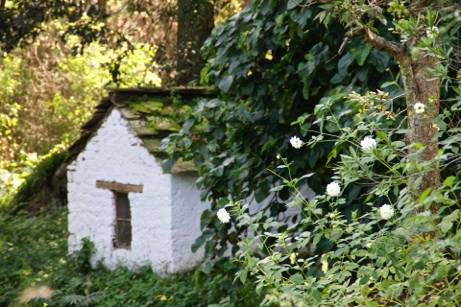
One of two photographs taken at the same time in 1911 at Prayāg, in the form of Śiva with the serpent and the moon; the other was in the ordinary form, with the kurta and the cap — the first photograph in this book.

Mahā Prabhujī in the form of Śiva, bestowing blessings through the third eye.
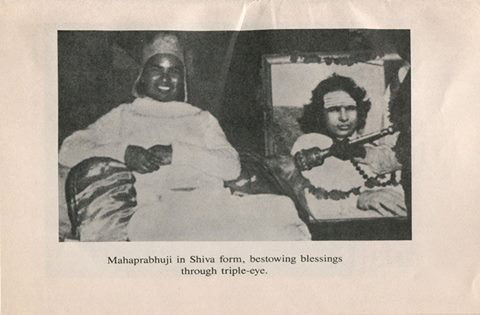
THE REGION OF ŚRĪ HAIḌĀKHĀN
That day too arrived at last! In the dark fortnight of the month of Āśvin (the seventh month of the Hindu calendar), towards its close, I visited the place in this body of mine. It lies thirteen miles from Haldvānī, in the district of Nainītāl. The road is hard. Below the mountain of Kailāś, on the banks of the Gautama Gaṅgā, there is a village called Haiḍākhān. Here a medicinal plant called harad grows in great abundance, and from it the village takes the name Haiḍākhān. Forty years ago the road to the place was very difficult, and it is not easy even today, though horses can cross it readily enough. A motor road, moreover, is now being built. At present there is a forest post, a government hospital and a school, and a few shops have opened. There is scarcely any danger now. This is the place where Śrī Prabhu had built the first temple of Śiva, and so people began to call that nameless, Eternal Being Śrī Haiḍākhān Bābā. The temple, the dharmaśālā (the rest-house for travellers) and the place of the sacrificial fire were all built by Him.
First of all, Śrī Bhagavān appeared to several people of the village in a cave shaped by the Divine itself. This cave lies on the far side of Haiḍākhān, near Kailāś, and it seems the very throne of a sovereign emperor who owns no master. The peace, the joy, the beauty and the experience one has there are past describing. It is a cave in name only; in truth it is a temple raised by nature herself. It was in this cave that Śrī Mahārāj would from time to time grant audience to seekers and take them under His protection. From many old and discerning people I have heard of the divine works He performed in this place, but I shall not write of those episodes. I write only of the blessed things I saw with my own eyes by His grace, and of the nectar that fell from His lips and that I heard with my own ears; these I set down briefly.
I sat down in the sacred cave. A few days before this the cave had been full of water from the floods, and so it was still quite damp. I had with me a large sheet: half of it I spread beneath me, and with the other half I covered myself. In this way I passed three or four days in the cave. The villagers brought me food each day. One day a devotee brought rice straw and pressed me to let him spread it on the floor. At night, when I had fallen asleep, there came a sudden noise; I thought it must come from the straw, yet the straw lay undisturbed. I got up quickly, but hardly two minutes had passed when I heard the noise again, and twice as loud. In this noise only the resonance of the sound was doubled; the tone was the same. I began to feel drowsy and frightened at once, and because the drowsiness was so heavy I thought it better to try to sleep. No sooner had I fallen asleep than I heard the strange noise once more, louder now by double again; so I rose immediately, without a thought in my mind, and sleep left me. I marvelled at myself, for I had lived before in fearful forests and among the mountains, yet never had I felt such fear. What strange circumstance was this, that made my courage fail? Well, whatever Śrī Bhagavān sent me was for my good; so I thought I would recite my prayers to Him, not out of faith nor out of fear, but merely to pass the time. As soon as I began to recite them, consciousness left me, and in that state I composed the prayers that are called Śrī Munīndra Sūkta (prayers to Śrī Munīndra). They were composed through the power of Divine Grace. The uttering of these verses gave me the keenest joy, but after repeating them once I began to forget them. This forgetting did not please me, and I said to myself: "What is the use of a non-attachment such as this?" Indeed, had I had a pencil and a light, as that villager had advised, I should have been able to write down these beautiful invocations to Śrī Bhagavān just as they were composed, for the blessing of mankind. I thought too that if they had been inspired by Śrī Bhagavān, then He could not forget them. The merciful Lord would bring them back to my memory in the morning; and if they were truly His own, there was no harm in my forgetting them. Many verses of this kind are composed. Only the words of a saint have power. With such thoughts in my mind I went peacefully to sleep, and did not rise until eight in the morning. A teacher from the village school used to come to the cave to bring me milk; seeing me still asleep, he said: "Mahārāj, are you still sleeping? I take you for an educated man — here, take this pencil and this paper, in case you should wish to write something." Then he went away. I decided to drink the milk only after I had written down the verses to Śrī Bhagavān that had come to me in the night. I told myself that if they were revelations from Śrī Bhagavān they would return somehow to my mind. With the paper and the pencil I sat down beside the Gautama Gaṅgā, on a stone facing the cave, and after a short prayer I began to write. Ah! In that moment every word of the invocation stood forth as though lit from within! With overflowing joy I wrote down those shining, mantric words, my hand trembling with emotion; then, thanking God for His illumining grace and greatness, I drank my milk. These verses, like the Sūktas (invocations) to Śiva, to Lakṣmī, to Rātri, are now recited by all. There may be some grammatical error in them, but this is no literary composition. They are a blending of Divine Music, Divine Words and Divine Faith. They are as follows:—
"Śrī Munīndra Sūkta" — a prayer to Śrī Munīndra
Kailāś giriware ramye nivasantam sushantibhih
Tam Munim satatam vande sada karunya rupinam.
On the fairest peak of Kailāś He dwells in perfect peace, the most compassionate and the most beautiful; to Thee I bow for ever.
Yasya smarana matrena siddho bhawati sadhakah
Sadgurum tamaham vande Haiḍākhāṇḍ vasinam.
Merely by remembering Thee a devotee gains all the occult powers and becomes a saint; to that great Being of Haiḍākhān I offer my homage.
Yasya kripa katakshena dhanyo bhawati manavah
Tasya padyorekam pranamami nirantaram.
Whose simple countenance makes a devotee blessed; at His feet I bow without ceasing.
Komalam hridayam yasya komalam yasya bhashanam,
Dandoapi Komalo yasya komalangam namamyaham.
He whose heart is full of tenderness and whose speech is strangely sweet, whose very punishment is gentle: again and again I bow to Prabhu, adorned with delicate limbs.
Drishtim dayamayim kritwa yah pashyati characharam,
Lokopakar nirato ragadveshadi varjitah.
He is exceedingly kind to all the beings of the world, untouched by any bias of attachment or aversion. He (God) who is ever engaged in the welfare of everyone — to Him I offer my humble homage.
Sadguru sadgunadharo dhyan gamyah sadashayah,
Satyam param chidanandam samsamaramihi sarvada.
Adorned with a heart full of compassion, accessible to those who meditate upon Him, He is the upholder of all the virtues! I pray to Him at every moment, the Almighty Lord, Truth, Consciousness and Bliss incarnate.
Hari-Reva HarerBhakto, Harerdhyana parayanah,
Harernamamritam pitwa Harerdham param vrajet.
As the object of meditation, He is Hari Himself. As the one who meditates, He is the devotee of Hari. The meditation itself is concentration upon Hari. Thus in these threefold aspects — the meditation, the meditator, and He towards whom the meditation is directed — drinking the nectar of His name, the worldly man attains salvation.
Yo dadati cha balanam sadgyanam tu su durlabham,
Sarva sadhan hinoapi twamekam avalambanam.
Thou who blessest men with knowledge when they are caught in the māyā of the world: O Lord, though I am destitute of every means of approaching Thee, Thou alone art my support and my refuge.
Maha Martanda rupena mohadhvanta vinashakah,
Sarva bhutatma rupoasi Mahendrasya cha jivanam.
Thou dost dispel the darkness of ignorance in the hearts of Thy devotees, lighting up their unknowing in the form of the sunlight of Thy wisdom. Thou art the pure spirit in the hearts of all creatures, and Thou art the very life of this "Śrī Charaṇāśrit Mahendra".
I stayed three or four days in that cave. Without any effort I was able to compose many intuitive invocations and prayers. Some of them gave certain teachings; others held inner meanings that need deep study before the beauty of the Sanskrit verses can be understood. But I tore up all my compositions at once, keeping only the 'Sūkta'. This poetic inspiration had come upon me as a shock. I thought within myself that from my boyhood I had prayed to God that I might desire neither wealth, nor acclaim, nor beautiful women, nor the art of poetry; yet today, by His grace, I had gained this very power and was using it with such delight — so it was nothing but a flattery. And so I set out for Haldvānī. From Haiḍākhān, that is from the cave, to Haldvānī the road passes by the Śiva temple and through the village; but I did not take that road, since the villagers would have kept me from leaving. It was three or four in the afternoon, and they had already tried to stop me on account of the danger of the road. But I wished to leave the cave at once; so, crossing the river and following a very hard path, I walked on and reached Haldvānī at eleven at night.
The Śiva Temple at Haiḍākhān
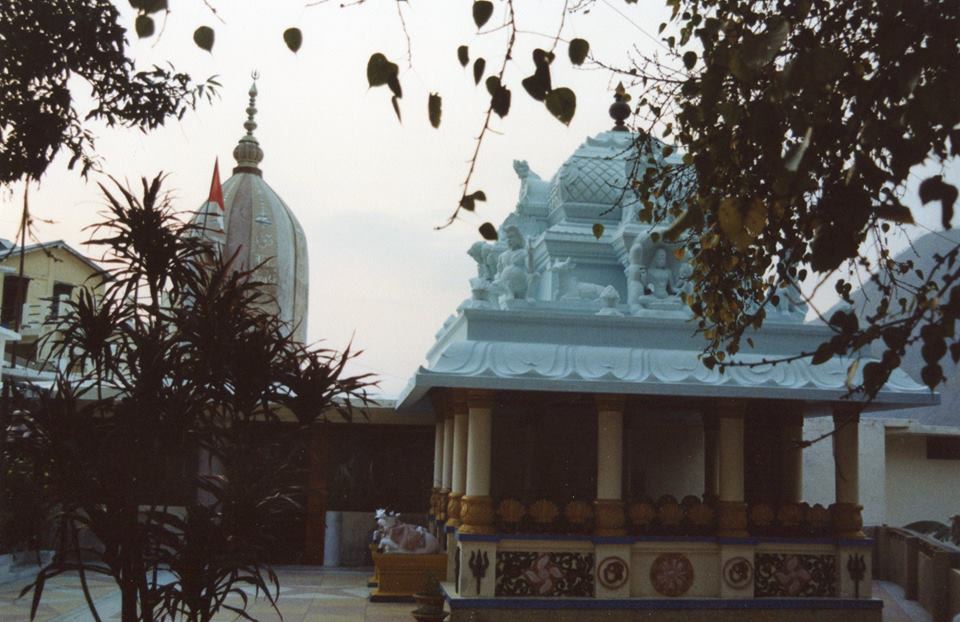
So great are the grace and the glory of the Lotus Feet of the Guru; only for this does Śrī Bābājī choose to manifest as a Sadguru, for the welfare of every soul
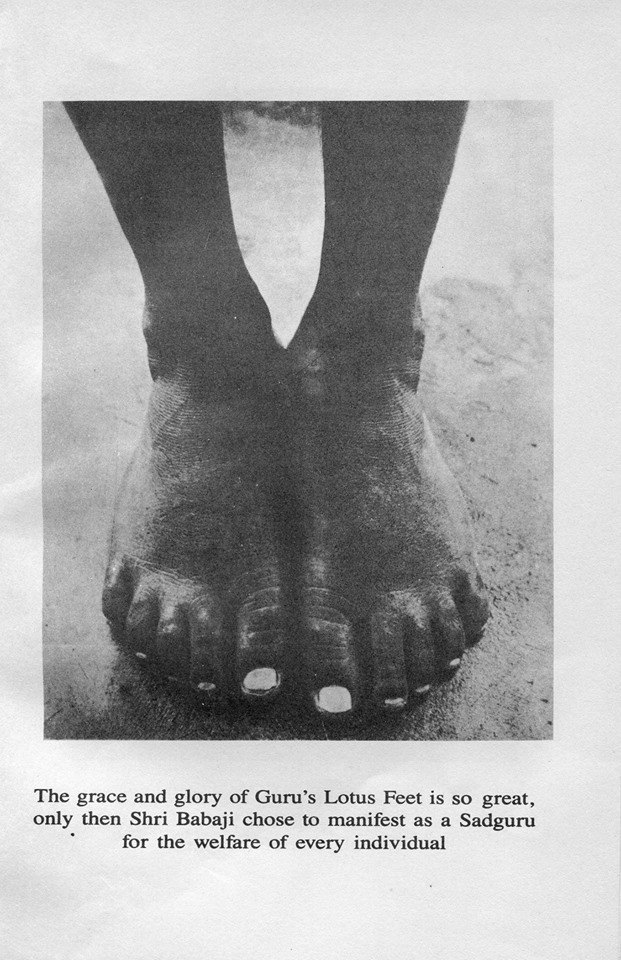
Śrī Haiḍākhān Bābā and the five-faced Śivaliṅgam — Haiḍākhāṇḍeśvar Mahādev, in the octagonal Śivālaya at Haiḍākhān.

AGAIN AT SIDDHĀŚRAM
After wandering here and there for some days, I came once more to Siddhāśram through the unmerited blessing of Śrī Prabhu. It was my custom to go there every second or fourth month, but I have written briefly, and only of those occasions on which my pilgrimages led to the special events set down in this book. These recollections are of His manifestations. On this particular pilgrimage several people travelled with me. At Haldvānī the annual worship of Śrī Mahārāj was kept with great devotion and splendour. Many of His devotees came from distant places to attend that function, and some of them went on with me to Siddhāśram. It was the eleventh day of the bright half of Vaiśākh — Tuesday, 20 May 1952 — when this blessed and grace-filled happening took place. The hour was some three or five minutes before eleven. In broad daylight, under a white sky and in clear air, this blessing came down upon those ripened souls. The event was unmistakable from every point of view. I had gone to rest after eating and had been asleep a while. Suddenly I woke and opened my eyes; with no purpose in mind I walked out onto the veranda and sat down facing north. Three people were there at that moment, and among them a woman whom I had sent to fetch water from the river for no particular reason. She set off at once. No sooner had she gone, and my glance fallen straight ahead, than I saw a beautiful shining light in the shape of a human being. That radiance cannot be told in human speech. "O Lord, lead me from darkness to Light." This Light, sighed for and adored by the great Ṛṣis, is unlike anything else whatever. Moonlight, fire, the sun, lightning, the white blaze of crystal — none of them bears comparison with that radiant Light. It was wholly beyond description, and it was like a flame of pure ray. At noon in the heat of the summer months, when the sun burns at its brightest, even then this wonderful body of Light showed forth its whole splendour in unmixed beauty and brilliance! This Light must have stood about half a mile from the āśram in a straight line, and some two miles by the road, and it could not be reached directly, for deep ravines lay between. The sight of that Radiance put me in mind at once of Śrī Bhagavān; such things happen again and again by His blessings. For a while I lost all awareness of my surroundings, and then once more I had a swift vision of the Divine Light. Sitting there, I worshipped it inwardly with great reverence, and I blessed these eyes, which had been granted the sight of a light pure as the amethyst; by that vision I was simply made luminous. A pilgrim seated near me had no notion of the wonder that had taken place before him, and it was not right that he should remain ignorant of so sacred an event. So I called his attention to it, saying: "Look at this rarest of sights, granted to you so easily today; look in front of you at what the Light is." Seeing the light, he was struck dumb. In such places concentration comes of itself. He too was made happy by the vision. On occasions of this kind I deliberately hold back from writing or speaking of them. It is impossible to describe such a hidden marvel perfectly. "O Mother, I hold it beyond the power of reason, mind and speech to describe the shining form of Śrī Rāma, for it is a matter of self-realisation alone. It is as if a mute man tried to tell it in words; yet to some deserving souls it is granted even so." It is so because such events help new aspirants to gain firm faith. I was still speaking of this vision with the man who was with me — the one to whom the Lord had granted the sight of His blessed form, that it might be set firm and clear in his heart — when the woman returned with the water. It came as a kind of shock to her to hear of that happy vision. She thought the grace of Śrī Bhagavān had no meaning for her. She believed it was because she had not been constant in her prayers and hymns, and that this was why I had not made the blessed vision possible for her, since she supposed that I, Bābā, knew all things. I explained the matter to her, but she held firmly that I had given my companions their chance to see. How could I tell her that the same vision would be given to her the next day? The compassion of Śrī Bhagavān is vast, and the Lord heard the plea of that piteous woman. He bestowed His vision upon her and satisfied the longing of them all. This woman was sleeping at that hour. When she heard of it she grew sadder still. Then the Lord, showing His great blessing on the third day also, and at the same hour, gave a vision in that same form of Himself, though the brightness of it was somewhat less. Present at that moment was a fortunate little boy of about seven named Gopāl Prasād; he was like a Dhruva of our own day. In wonder the child said to his mother: "Mother, what is it that shines?" These blessings were showered upon us on each of those days — the 20th, the 21st and the 22nd, that is, from the eleventh to the thirteenth of the Hindu month. A vision so hard to win even for great yogīs, and today so easily given! What is there to say? Reverence, unceasing reverence, to that great Compassionate Power. To me and to many devotees the privilege has very often been given, by His grace, of being blessed with such visions and such words; and often, through His vision, He protects many in many ways. To some He gives peace by bestowing knowledge. To many He showed Himself. To the many afflicted with dejection and anxiety He showed Himself in that very form in which they worshipped their Deity and longed for its sight. Many who were without hope and full of care were made calm. Many with no learning and no religion, having heard or read of Śrī Mahārāj, became followers of the spiritual path. All began to think of worshipping and serving this true Master, so great and of supreme realisation, each according to his own feeling. Śrī Bhagavān took on this form of the Guru to fulfil every desire. The divine līlās of Śrī Bhagavān go on in the same way. I too have passed the greater part of my time at Siddhāśram, Haiḍākhān, Kāṭhghariyā (Haldvānī) and Vṛndāvan. At the urging of devotees I sometimes went far afield, but I returned to these āśrams and gave myself to His worship, so far as I could, together with other devotees. We used to speak of these things and discuss them with my fellow worshippers and with those who came — His name, the traditional rites, the vision itself — in truth, in simplicity and in love, so far as our understanding reached. After some months I came again to Siddhāśram. On this pilgrimage I resolved to carry no store of provisions. Pilgrimage in the Himālaya is hard, yet by His Grace I wandered there for years. Wandering so, I came to Siddhāśram. There was no one in the āśram at that time. After the evening rites the priest would go home, as he did every day. Just then I had only ten or twelve potatoes with me. I thought I could eat three a day, and after that leave the āśram; to go hungry in Bhagavān's āśram, or to ask food of Him, was unseemly. Better, then, that I should leave the place. With this in mind I roasted three potatoes at the fire temple, and afterwards was thinking of going to sleep, when again I heard that familiar voice. Divinely radiant, smiling upon me, looking at me with compassionate eyes, He said: "Bābā, stay here. You will receive money, and food as well." Ah, how greatly He cares for His devotees! The merciful Lord! With joy, and with amusement at my own littleness, I thought to myself what want of faith I had shown, that Śrī Mahārāj should speak to me of so trifling a matter! What — will you always be anxious for the keeping of your life? No; in this hallowed place, to fret over the upkeep of this wretched body is a thing to be laughed at. It is true that had no arrangement been made for my food I could not have stayed there. This was only one instance of the miraculous power of Śrī Bhagavān's līlā. The Compassionate One wished me to remain in that sacred place for a time. That very day I received abundant food from a number of people. Two or three days later, with no word beforehand, a money order for 201 rupees reached me. The sender had no idea where I then was, nor was it his habit to send me money. It was Prabhu, therefore, who had directed it. By His blessings I often stayed in this āśram for months together. There is always a longing to remain in a place that bears the marks of Prabhu's footprints, but at times I had to move elsewhere. Whenever the mind was drawn again toward Prabhu, I remembered Siddhāśram with love. On one such occasion I went to Siddhāśram in winter. Not having had sight of Him for many days, I grew impatient, and said to Him in supplication: "Lord, how am I to live so long without the sight of Thy face?" Ah! Even so faint a plea is heard so swiftly in the Lord's abode! The very thought of it sets a strange trembling in the heart. The next morning Śrī Mahārāj gave me a vision of His single limbs, one by one; sometimes His holy feet alone came before my eyes, sometimes my eyes were blessed by His lotus eyes, and sometimes His long arms, reaching down to His knees, seemed to bless the whole world! This blessing went on for a long while. In that hour the truth settled in my heart — not as fancy, nor as doctrine, but in fact — that Śrī Mahārāj is present in every atom of the universe. "This whole world is in the form of Brahman. There is nothing else save Brahman." The great sages have won this perception on such occasions. Whenever such events take place, their influence stays in our hearts with a deeper permanence. Because of these blessed happenings Siddhāśram became a place of great attraction for me, but this did not please the all-knowing Lord. Through His līlā, something now came to pass there. Once, in summer, I happened to come to Siddhāśram. Drawn by its natural beauty, I decided to stay and to fast for twenty-one days (the fast had no special purpose, save to lessen my sleep). On the day I began the fast, Śrī Mahārāj appeared to me at about six in the morning with a command.
The light went out in an instant, and only His voice remained. I could not see who was speaking. While the words sounded I felt as though Prabhu were speaking to me from a great distance, from outside the room. Then came the sense that Bhagavān was my own true soul, and I felt myself one with Him. He Himself was the speaker, and He Himself the listener. There was an indescribable oneness among the vibration of the words, the meaning of the words, and the words themselves. These mantras were very sweet to the ear. Śrī Mahārāj said: "Bābā, your spiritual unfolding cannot take place here." At that moment I was sitting on my bed. I had only just woken from sleep and was gazing at the photograph of Śrī Mahārāj. The instant I heard these words I went outside, but I saw no one for a long way around. I had not the slightest doubt that the words had been spoken by Śrī Mahārāj and by no one else. He alone, the Compassionate One, held His blessing over me with His unapproachable Grace. What more can I write of what came to pass in that almighty and great Siddhāśram? Many longings of the devotees have been granted there until this day, but I shall not write of them here. Such accounts have been set down, in various forms, in other books. Naturally, once I had received His command concerning Siddhāśram, my visits there grew less frequent — though it remained for me the most unforgettable of all places.
DEVGURU
Once the strong longing to visit Siddhāśram had lessened, and I hungered again for the sight of the Lord, I came to Haiḍākhān; and after resting three or four days I went up to Śrī Devguru. This mountain is held to be one of the most sacred of places. From here the snow-covered peaks are seen very clearly. It is believed from of old that here Śrī Bṛhaspati performed severe austerities for a long time, to win the blessing of Lord Śiva, and thereby gained the knowledge of the unfathomable. To this day there is a temple of Śiva upon the site of an ancient platform. The natural beauty of the place, its purity, and the divine fragrance the wind carries give the mind a wonderful steadiness that is found nowhere else. It works upon one in a most uncommon way. Near the Śiva platform there is a small cave; in it there is no room to rest or to stretch out the legs — one can only sit.
About a mile down the slope there is a little river nearby, and beside it rocks so shaped that they seem meant to shelter those in meditation from rain and sun. At this spot an ascetic had made his pūjā and his meditation for a number of years. Coming from Haiḍākhān, I stayed in that place for the night. Beneath the rock where I slept was the very spot where Śrī Mahārāj used to take His seat. This I learned from an old villager and from the ascetic. There, too, I had a vision of Śrī Mahārāj. The villagers told me that whenever Śrī Mahārāj came to Devguru He would sit there. The vision lifted my heart immeasurably; taking it for a good omen, I climbed up and remained two days without food or water. I felt neither hunger nor thirst. In great peace of mind I drew up my legs, covered myself with a thin cloth, and lay down in that little cave. This is a special place, where Śrī Mahārāj showed forth His divine play. Even to this day the remains of His straw hut are there. In these places of pilgrimage I gained non-attachment to earthly things, dispassion, peace and bliss; with no effort of my own I felt all-knowing and Self-realized.
The next day, in the early morning — it must have been scarcely an hour before the night ended, when all was very still — Śrī Mahārāj revealed Himself again and said, with great compassion and great quietness: "Bābā, have you come here to give up your life? You are as dear to Me as My own life." Seeing His measureless compassion, I was shaken. Even in a heart emptied of every feeling an ocean of love and tenderness overflows through the blessings of Prabhu. I began to weep bitterly, as though there were no one there before whom I need feel ashamed. The Lord of Compassion could not bear to watch His child weep for long. It is not in His nature to look upon anyone's sorrow; and so at once He gave me another vision of Himself, and His full blessings besides. I do not like to write of such occasions. Those who live through these things are not able to describe them. How can any poet put into words that subtlest Essence which dwells beyond all wisdom? It is won only through the experience of the Self. After a while, when my mind had grown composed, I thought the ascetic must be troubled on my account, and I resolved to leave that day. I was also making Śrī Mahārāj unhappy with my aimless wanderings. I paid homage to the holy place and, casting many an admiring look at its beauty, began to go down.
"That Divine Mother who is present in all beings in the form of Light." I had read the lines above many times; but on that day, through the boundless favour of Gurudev, I did not merely see Her present form — I felt myself an indivisible part of that beautiful shining Light. This was no imagination: every hair of my body thrilled with that feeling! Body, senses and mind together were in a state of blissful trance. After the experience came the feelings, and with them words to describe it. Yet words are powerless to express that state fully — as powerless as even the cleverest of people would be to describe how their own parents' wedding took place.
The ascetic was climbing up, halfway along the path, with two vessels of water. He said joyfully: "I had come up determined that if the great sage would not come down for his meal, I would stay with him. See, I am carrying two vessels full of water — one for use in the worship of Śrī Śiva, and the other for you. Come down now and rest there." I spent two or three days there. Then, passing through the village of Pashia, I slept the night in an ancient cave near Śrī Haiḍākhān. As soon as I entered the cave that evening, these words were heard from the Divine Source: "Bābā, you have come back from Devguru. I am very pleased." By His Grace I heard such divine utterances many times before I had any living experience of these things. Even then I used to read of them in the ancient scriptures, and I thought that only the pure minds of those sages could reach such a height — that we, who are without true discrimination, with shallow knowledge and slender resources, were striving in vain to reach the summits of those ancient ṛṣis who wrote of such experiences in the Purāṇas and the śāstras. Through my own experience I came to know that every word of that literature I had read bore the stamp of real truth. Every word was proved true in experience. After a stay of a few days at Śrī Haiḍākhān I came to Haldvānī.
HALDVĀNĪ
In the year 1954, in the winter, I was at Haldvānī, my mind perfectly composed — yet who can understand the divine play of Śrī Bhagavān? A great struggle began to rise within me: a feeling of deep unhappiness, a strange dejection, a bewilderment in my understanding. The restlessness was of this nature, that the mind said to itself: "You have told everyone that Haiḍākhān Bābā is Bhagavān Himself, and today the world is full of sin and sorrow. Śrī Rāghavendra proclaimed, 'O Lord, I regulate the working of that principle which gives men the fruits of their good and evil deeds.' If Prabhu works today upon such a principle, it will not be possible for the world to be saved. In the same way the Lord of the Divine Play, Śrī Kṛṣṇa, proclaimed, 'I am Yama, the devourer of all things.' According to that proclamation it can only mean the destruction of this world as it now stands: full of faults, stripped of every ideal, immoral in its very air, a society without any common good. In such a condition a God like Him in human form is needed — full of forgiveness, munificent, His words trustworthy and easy to understand — whose refuge may be sought without fear by all." This does not mean that other Great Beings were without generosity, forgiveness or humane conduct. It is an established truth that these qualities manifest their light and wisdom in great measure in such Great Beings; yet in certain incarnations of the Deity there is more display of the struggle between right and wrong, to keep discipline for the good of the universe, while in others the plays of the Lord have been emphasised. In some incarnations knowledge has been stressed, while in some He has seemed to teach only the path of Love. In the same way the avatār of Śrī Bābā has come to teach peace, forgiveness and compassion in their threefold Vedic aspect. In the past men used, in great numbers, to become holy as devotees of the Lord; today even beings of human character are hard to find in society. Taking human forms, demons live according to their own leanings, and the unfolding of human qualities is a far cry. Today, through this perverse turn of mind, human beings hold doubt and aversion towards the true methods of gaining salvation and progress. In such an atmosphere our Heavenly Father, who is forgiveness personified and a friend of every human being, shows all the powers of His unceasing pardon. This divine power of forgiveness can be seen only in the great saints. It is for this reason that Śrī Bhagavān the compassionate has shown Himself in the Kaliyuga in His aspect as a saint; the compassionate Buddha, holding non-injury to be the highest of qualities, took incarnation in this very yuga. The much-disputed Śrī Kṛṣṇa Chaitanya Mahāprabhu, the giver of the joys of heaven, held the arduous rituals to be lower than the simple recitation of the name of Hari, and through that incarnation he taught this truth. In the present age Śrī Bhagavān comes in the semblance of a saint, Śrī Haiḍākhān Bābā, and as such He resembles a self-realised soul. The purpose of these Avatārs differs in different times. The same Lord Viṣṇu takes different forms and names and comes into the mortal world. At this hour the Lord must appear in this form. In keeping with the need of the moment, this supremely peaceful form of incarnation is necessary. All who heard of these events agreed. My companions from Kumaon and other devotees set aside every other kind of worship, and began by paying homage to Śrī Bābājī Mahārāj, and so began His adoration. Everywhere this Avatār was spoken of and worshipped. And yet, unexpectedly, a doubt began to grow in my mind: in this world there have been many self-realised saints. Though in these days not all their occult powers are fully present, many beautiful faculties are still found in these great adepts. What proof is there that Śrī Haiḍākhān Bābā is not such an adept, but the very incarnation of Brahman? There is a world of difference between the worship of God and the reverence offered to an adept. Though God is present in every form, His own Avatār is still beyond compare with any other. I thought that if Śrī Haiḍākhān Bābā is not truly Bhagavān, then those who cease
worshipping Rām, Kṛṣṇa, Śiva and Devī and worship Śrī Bābā as Bhagavān will not be able to obtain salvation. I have told these faithful devotees that He is indeed Brahman. They have taken my assertion as profound truth, and are following their devotional practices accordingly. I shall be leading these faithful devotees astray if Haiḍākhān Bābā is not God incarnate; in that case I shall be deceiving them. Only when I see with my own eyes that the Sacred Form of Śrī Bābā is the same as that described in the Vedas, the Purāṇas and the Tantra Śāstras shall I be fully satisfied and obtain peace of mind. This inner conflict went on for four or five days. By the blessings of the Lord, in the half-light of the month of Māgh, on Sunday the 24th of January 1954, I and another devotee, Bānkelāl Pāṭhak, went out to walk along the Golā river; it must have been nine or ten in the morning. The Haldvānī aerodrome lies a mile outside the town (another is being built), on the bank of the Golā. Formerly there was a great wood there. Even now, beyond the clearing, it is thickly forested. Tigers too are known to prowl there. The said devotee and I went towards that forest. After a distance of about two hundred and twenty metres, a path made by the woodcutters could hardly be made out. Naturally I wondered how we were to go on, since we could no longer see the way and there was no one to show it to us. This thought came in an instant and vanished. I was walking in front, the devotee following me with a vessel in his hand. I was walking with my eyes on the ground, and at a distance of about thirty feet I saw the form of Śrī Bābā drawing near. I understood that this form was different in every respect from all others. This was His real, eternal Form. Whenever Śrī Bhagavān has incarnated for the good of mankind, the descriptions of those forms are plainly the same as those given in the scriptures and by the great saints. It was that same form of the three divine eyes — Bhagavān Śaṅkar, easily pleased, His throat blue from the drinking of the poison — and He was coming towards me in a calm and peaceful composure. The look of His eyes pierced my heart and stayed there like a shaft of light. From a distance I made obeisance to Him in my mind. My hands were not clean, and I did not like to touch His holy feet. No sooner had His eyes fallen upon me than I forgot everything. I forgot my very sense of myself. In a state of half-consciousness I asked Prabhu: "Is there water down there?" Śrī Prabhu answered in a voice grave and sweet: "There must be." Again I dared to ask Him: "Where do You come from?" Śrī Bhagavān answered simply by pointing towards Śrī Haiḍākhān. By the blessing of His sacred feet I understood completely that this Śiva incarnate as Śrī Haiḍākhān Bhagavān had come here to relieve me of my doubts, and to bless me with the vision of His all-pervading, omniscient, self-born Form. Yet together with the joy and the peace I felt also a great shame: "How unworthy I am, how faithless! Even saints and sages find it hard to obtain this blessing, which He was giving me so easily and so sportively — and even so, like a fickle, ignorant and bigoted child, I try to measure His greatness!" This thought too passed at once. Neither I nor the devotee at my side could tell how I came back from the road, or how the devotee stayed with me. Śrī Mahārāj was standing to the right, before us, at a distance of some seven or eight feet. So great was the brilliance all around from His three eyes that, though I tried with all my strength to obtain a vision of His whole form — and notwithstanding my deep humility and His blessings — I could obtain only a vision of each part of His form separately. The nectar of that vision brought my mind to complete contentment. Only His sacred feet, His lips, His divine eyes and His lotus hands were seen entire. The other dazzling divine parts, giving a partial vision yet drawing out great love with a penetration that lasted but a moment, stirred my mind and made it a prisoner, a slave for ever. Ah! When by the infinite Grace of God I had a vision of His toenails, like so many moons, I could no longer describe what I felt! How can I describe the state of my mind in that hour? Returning home, that devotee said to his wife: "At the sight of Mahārāj, Bābā became what a faithful wife is at the sight of her husband." Whether the devotee is a poet or not, he said something very true. At the sight of the nails of His feet, not only my mind, my intellect and my life, but this physical body too became a flame plunged in that radiance! Whatever form I saw in that moment appeared to me as the Almighty Himself. When I had sunk deep into these thoughts, Śrī Bhagavān looked at me and began to speak to the devotee. Śrī Mahārāj said to him: "I have come here to gather firewood, but none is to be found; I must go to Bhojipura, and I shall take the train from here." As He said this He was looking at me. From that simple look of His I became His own, free of all self-will and desire. The words from His blessed mouth drew me to Him. After a time Śrī Mahārāj said: "I have not eaten for three days; I could not gather any firewood." The devotee took Him for an ordinary young boy, but to me He was revealing Himself in His real form as Śiva. He was showing me His blessing through His three eyes. Even while He spoke to the devotee, His lips did not move. It is impossible to describe the state of things in that hour. At Siddhāśram Mahārāj had been in the garb of a saint; but that day He was granting my prayer, "O Śiva, grant me a vision of Thy serene Self." When I heard the word hunger from His sacred lips, my mind, which had been drowned in the majesty of the Lord, forgot all that majesty; I said to myself that I would give Him a few paise with which to buy gram to eat and water to drink. What else can be done in such a place? (How contemptible the mind is! Ah, the whole wealth of life is standing before me with all its blessings, and this mind — what does it think of giving Him for food!)
So I asked the devotee in a low voice, "Bhagatjī, have you four paise?" The bhakta said, "I have a two-anna bit." I told him to give it to Him. The moment the devotee put his hand into his pocket, the Lord of the World, the Giver of Abundance, stretched out His hand, and the devotee tossed the two-anna bit across the distance. I did not know where the coin went; I saw only that it was travelling towards His outstretched hand. Loveless as I was, I walked on, thinking that I would first bathe and then return — but the compassionate Lord had stayed where He was. With great generosity He said, "Bābā, your wishes will be fulfilled. Go, you will attain salvation. I shall eat the gram bought with the four paise, and drink some water." Giving His blessing in this manner, He began to walk very fast. I was walking east and Śrī Mahārāj west; yet in that moment, somehow, I could see all around me, before and behind. Filled with a joyous contentment, I could not speak just then, but the devotee said, "Bābā, this is Śrī Mahārāj Himself." Amused, I asked him how he knew. He said that Śrī Mahārāj had always used those very words in blessing. I was pleased at his great good fortune. The devotee said at once that if He were truly Śrī Mahārāj He would speak, and otherwise there would be no answer at all. "I cannot shout," I said. "Call Him aloud." At first the devotee had taken Him for an ordinary young man, and so, even after this experience, he called Him 'Lālā' (a lad). The devotee cried 'Lālā', and from the other side, in the same instant, came the answer — "jī" — as though one and the same person were replying. The bhakta was astonished; it seemed that a single word had been uttered: "Lālājī". I said to him, "Run and take the darśan of Śrī Prabhu." The devotee ran as fast as he could. For my part I was amused, and said to myself, 'Poor devotee — is there anyone on earth who can reach the Lord by his own strength?' As the thought entered my mind I called out to him, "Bhagatjī, have you seen Him?" The answer came: "No." Standing on that very spot I called out again, "Stay where you are and do Him homage with folded hands." The bhakta stood there with folded hands and paid Him homage with lifted eyes. The Omnipresent Lord had compassion upon him, and the devotee received the blessed vision of Him face to face. In gown and cap, high in the sky, some two hundred feet up, lit with divine light, Śrī Haiḍākhān Bābā was seen ascending. The devotee too was overjoyed at this vision. Only then did he understand the līlā of Śrī Bhagavān. Then he said to me, "Bābā, that is why you had grown so calm. He is the Supreme Śiva Brahman Himself, Haiḍākhān Bābā! At times I have doubted, but in His great compassion He has taken my doubts away for ever." Listening to him, I too became glad. For several days that joy filled the devotee's whole being in large measure. The conviction took firm hold of him that Śrī Bābā was the full incarnation of the Lord. This experience has been granted to different people at different times. Thirty years ago in Kumāon (Himālaya), where the divine play of Śrī Haiḍākhān Bābā was an everyday matter, such great experiences took place, and the proof that He was the full incarnation of Śrī Bhagavān came all at once. "He cannot be measured by any standard. He who is the proof of all things — does He Himself stand in need of proof? There is such a question and answer in the Śruti: 'In what is Brahman founded? In His own resplendent Self.'"
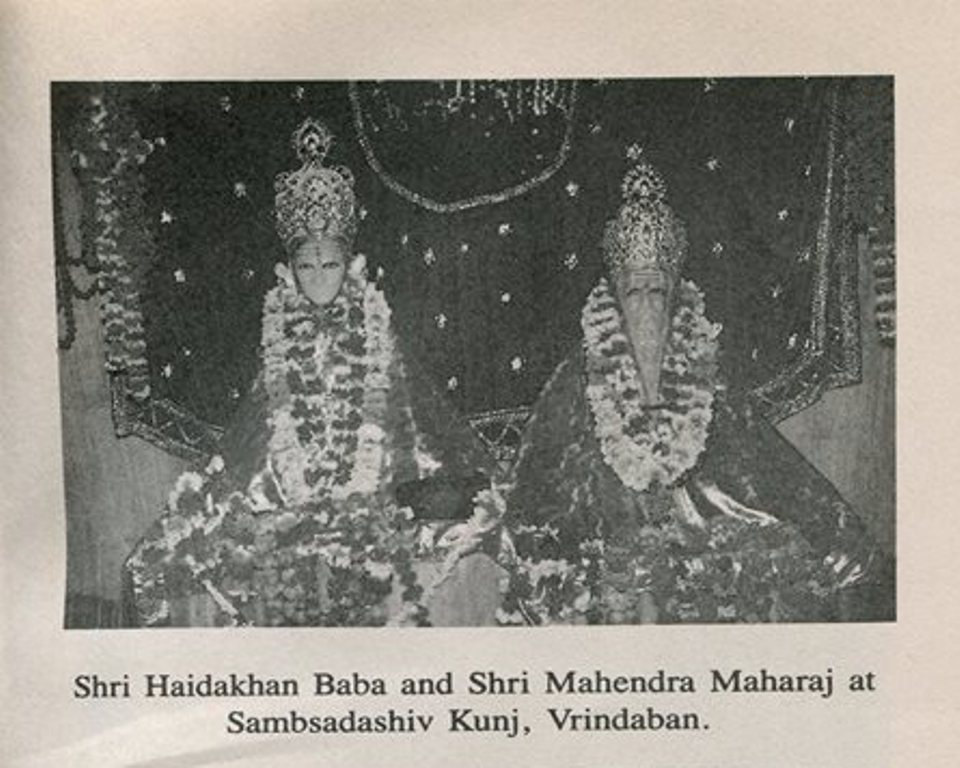
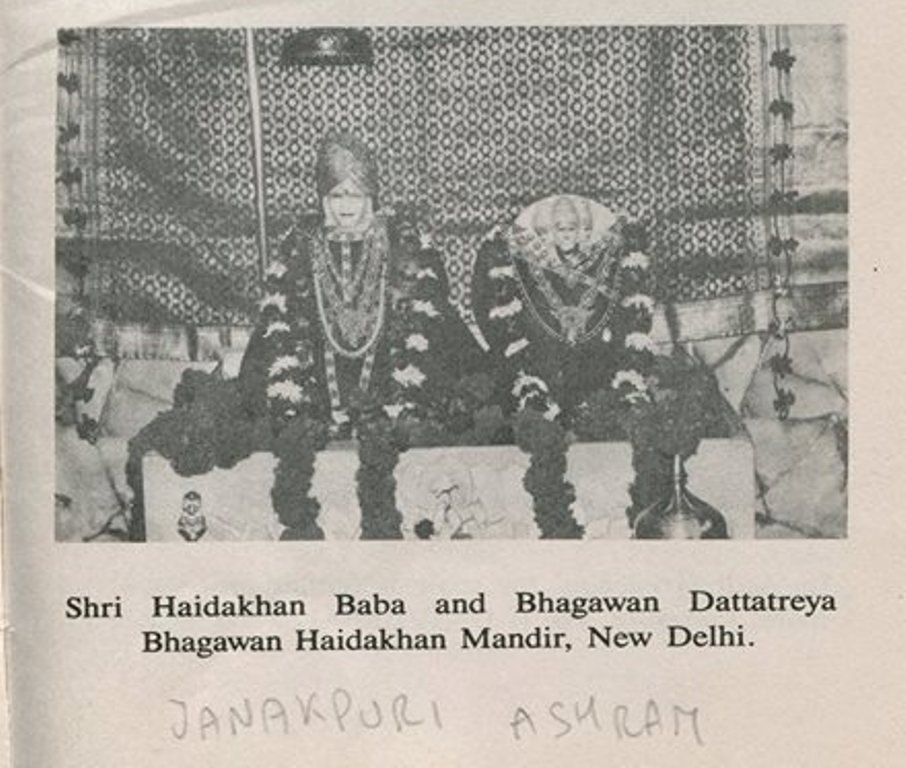
In the 'Ardhanārīśvara' the masculine is the feminine and the feminine is the masculine; therefore He is also THE UNIVERSAL MOTHER
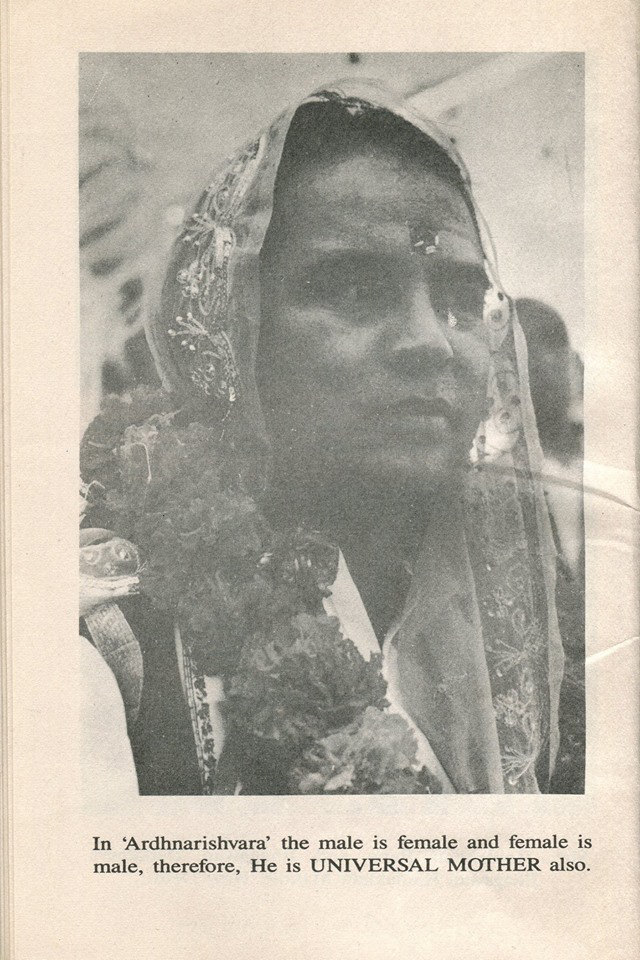
VṚNDĀVAN
Once, on the occasion of a solar eclipse, I was bathing at Kachlā Ghāṭ on the Gaṅgājī, and I was thinking of going on to Vṛndāvan when the bath was done. While I bathed I recited the mantra of my Guru, and I prayed to the compassionate Lord, Śrī Haiḍākhān Bābā: "Prabhu, Thou art Īśvara, the refuge of the whole creation, the incarnate and ever-existing Guardian, the compassionate Lord." It has been said:
"O Lord, Thy supremely resplendent aspect is the complete form of God; O changeless God, there is none in the universe who is Thy equal."
And so, I said, at Vṛndāvan I shall receive a divine vision of Thee in the form of Śrī Kṛṣṇa. I made this prayer, and then I forgot it. There is no doubt that Śrī Prabhu, Śrīman Munīndra Śrī Haiḍākhān Bābā, the Great Lover, and the blissful Lord Śyām of Vṛndāvan are one and the same. My forgetfulness came of my own want of devotion. The blessings were beyond question the work of His grace; they were never granted for any merit of mine.
At Śrī Vṛndāvan, on the spot where Vaṁśīvaṭ once stood (the banyan tree beneath which Śrī Kṛṣṇa played His flute), the Divine Player and His own soul-mate, the daughter of Vṛṣabhānu, were holding their play and their dance. It must have been about ten o'clock in the morning. A great crowd of onlookers was present. Suddenly this thought came into my mind; my mind slipped its moorings, gathered itself, and felt itself one with all, living in nothing but peace, joy and perfect wholeness, emptied of every outward awareness. I said to Śrī Kṛṣṇa: "Beloved, all my desires will surely be fulfilled — I have already received everything through the blessings of my Guru. But if Thou wilt grant me the vision of Thyself, the dark-hued One who is the very life of the gopīs, the darling of Nanda and Yaśodā, the true core of joy and gladness of Thy companions, the perfect form of beauty, matchless, my one idol — then I shall worship Thee also." Śrī Kṛṣṇa is of a most gentle nature and answers prayer to the full. Ah, His compassion! Śrī Prabhu Chaitanyadev said: "O Prabhu, King of the Yādavas, reciting verses in Thy name even this fallen heart feels itself lifted up."
The śāstras and the saints speak of His blessings. Many instances are cited of how swiftly Śrī Bhagavān has answered the petitions of unruly and unworthy people. This case of mine also may be taken as one more repetition of that. Call it a prayer, or call it an argument with the Beloved Lord — the thought had barely finished crossing my mind when, there and then, beside the great banyan tree, a deep and mighty current began to flow. Robed in a shining blue, Śrī Yamunā flowed on, and there the two had made their place of play. On the bank of the Yamunā, beneath the banyan tree called Vaṁśīvaṭ, clothed in yellow silk, stood Śrī Kṛṣṇa, faintly smiling, glancing from the corners of His eyes and playing the flute, softly and tenderly. Black curls framed His smiling face and lent a further beauty to His aspect. The golden earrings did not merely make His divine face more lovely; they gave the beholder a direct glimpse of the exquisite appearance of Śrī Bhagavān. The whole beautiful creation, Cupid Himself, the gentle Boy, the beautiful Śrī Kṛṣṇa — how long can one go on repeating the immeasurable wonder and loveliness of His features!
Yes, this is the truth: "When the vision of Śrī Bhagavān has conquered the heart, then the Divine form is seen everywhere." Those eyes, faintly red like a great lotus petal, had become a storehouse of joy and love. At the sight of those beautiful curved brows there flowed in my heart a sea of boundless love, of unheard-of charm, of endless delight; and Śrī Kṛṣṇa gazed at me steadily, without once closing His eyes. From the smiling lotus of His mouth there came, now and again, the notes of the flute. Śrī Bhagavān Kṛṣṇa, the son of Nanda, was seated beneath the banyan tree with His legs stretched out — not upon a throne, but upon a clean patch of ground: one leg extended, the other laid across the thigh. There was no garment upon His body, only a garland of wild flowers of many colours. It never occurred to me to look up towards His crown. It was very hard; I could not lift my eyes from His eyes. They were so radiant! I felt as though my sight, reaching the gaze of His eyes, found their brilliance so great that it forgot its own natural office and became like a fish swimming in that ocean of love, made senseless with joy. I do not know exactly how long this state of mind lasted, but it lasted long. Then I awoke out of it, and saw again the same banyan tree, the same house where the circular dance was being staged, the same notes of the tablā and the sāraṅgī (Indian musical instruments), the same players and the same spectators; and I became my old self again. My state of mind did not remain what it had been in the presence of Śrī Bhagavān! Śrī Kṛṣṇa said nothing to me, and I said nothing to Him. I was made content simply by the sight of Him. This condition of my mind is owing to the blessings of Śrī Mahārāj. From my childhood I have believed that to ask Him for anything is to obtain that thing — but not to obtain Bhagavān. To ask Him for something is therefore to be false with oneself. A mother longs to give her child things of great worth, but the ignorant child is stubborn and asks only for toys. So it is with the devotee who has no faith in His blessings, His generosity and His power: he begs his Beloved to grant his petty desires, and these, once granted, satisfy him for a little while — until another desire is born — and he loses all eagerness for realization. It is natural to want things and to ask for them. But He who is not only our very being but who also pervades the Cosmos, who is present in every atom — what need is there to tell Him anything, or to ask?
That Being is one's own self in its true, pure and accessible form. To beg of Śrī Bhagavān for trifles, and to expect Him to satisfy our desires through entreaty and prayer, is a mark of immaturity.
There is the knowledge of the Supreme Spirit, the Supreme Play and the Supreme Love. There the seeing, the seer and the seen melt wholly into one; the devotee and the Deity are one! It is truly beyond telling. Ah, what a great union! The devotee becomes God, and Bhagavān becomes the devotee! Without it this divine happiness stays out of reach and unexperienced. Only the attainable blessing, the indelible memory, the divine consciousness of Sat-Chit-Ānand (Truth–Consciousness–Bliss), incomparable and born of His divine play — the vision I was given of His translucent beauty, the Beloved of Rādhā, which brought me a joy beyond all measure — in a certain sense my heart alone can know it. Perhaps it is impossible to describe. "The word has no eyes, and the eyes have no power of speech." If the word had eyes and the eyes were given the power of speech, then perhaps this peerless mystery could be described. In that hour every hair of my body thrilled with joy. I was in a state of utter rapture. These words alone came out of my mouth: "The Great Guru Śrī Haiḍākhān Himself is Kṛṣṇa. Śrī Kṛṣṇa is dressed in robe and headcloth, appearing as Śrī Haiḍākhān Bābā!" I felt as though every atom were proclaiming this song along with me: "The peerless blessing of the Great Guru alone is the essence of all things. I bow before that gentle Kṛṣṇa."
In the reciting of these very names there dwelt that same deep peace and beatitude. Just as one breath follows another without any conscious effort, so these sweet names, these great mantras, went on repeating themselves in my mind even in a state of unconsciousness.
As soon as the Rāslīlā (the dramatic form of the circular dance) was over, I left the place, thinking again and again of Śrī Kṛṣṇa and of that mother of the whole world who is compassion incarnate, Śrī Rādhā. All the accounts of Śrī Kṛṣṇa's compassion that I had heard from the Purāṇas and from the writings of the bhaktas seemed to me that day more authentic and more believable than ever.
Many other things happened besides at Śrī Vṛndāvan. I have deliberately said nothing of the favours bestowed by Śrī Nikuñj Bihārī, the beloved son of Śrī Haridās. The blessings of Śrī Bāṅke Bihārījī — that is, Kṛṣṇa — have come to me often. Many times at Vṛndāvan, and once even in the presence of a devotee, Śrī Bihārī appeared in His blissful form. Many other events took place as well, but I would rather not write of these delightful happenings; I shall close this chapter by describing one such occasion only.
It happened on the 21st of September, 1955. That year I had gone to Śrī Badrīnārāyaṇ. I stayed there with an ascetic from Bhoṭ Pradesh (near Bhutan). Almost every day I spoke with him of Śrī Mahārāj. He too had known of the greatness of Śrī Haiḍākhān Bābā from his own childhood. He longed intensely to obtain the vision of Śrī Bhagavān. He felt as though he could kill himself for the pain of his separation from Him. He was in the habit of reciting, in a voice full of passion, the songs of the gopīs from the Śrīmad Bhāgavat and the Bhaṅvar Gīt of Sūrdās. It made me unhappy to see his restlessness, born of his longing for the presence of the Lord; but how could I ease his sorrow? So, encouraging him and calling to his mind the uplifting nature of Śrī Bhagavān, I left the place. At my departure the ascetic was as sorrowful as if something very dear to him were slipping out of his hands for ever.
From Śrī Badrīnārāyaṇ I came straight to Vṛndāvan by way of Haldvānī, while the ascetic remained at Śrī Badrīnārāyaṇ according to his usual practice, which was to stay there six months. One night he was meditating in his hut, and in meditation he saw a small pool full of water, and in it photographs of Śrī Haiḍākhān Bābā. He was greatly troubled at the sight of them and asked who had thrown the sacred images there. Little by little they grew more solid. He tried to lift them out of the pool. No sooner had he raised one than another appeared, and then a third, and so on, like playing cards. He struggled hard to bring back his ordinary consciousness, but this strange happening made him lose his senses. After a while, half-conscious, he was trying to come out of his hut when he heard, clearly and in a solemn tone, these living and thrilling words:
Śrī Haiḍākhān Bābā is All! Śrī Haiḍākhān Bābā is All! Śrī Haiḍākhān Bābā is All!
Hearing those divine words, the ascetic knew at once that they were not human. With great courage he opened the door of his hut; but there was no one there, and he was not surprised. The moment the words reached him he had understood in his heart that in that place the Devas themselves had given him instruction, and had blessed him with the knowledge of the form of Śrī Haiḍākhān Bābā. Of that place it is enough to say that an adept such as Śrī Nar-Nārāyaṇ Bhagavān performed His austerities there. The hut stands at Śrī Badrīnāth Purī, on the far bank of the Alaknandā. It is, of course, a solitary spot. At night especially — in the cold, on a path strewn with thorns, now climbing, now falling away — who would come there without a reason?
The moon was bright, and all the space around was filled with light. A man's own inner feeling is the best witness; yet the fact remains that, being a Divine Expression, it was given to him in a form that could not be mistaken. The ascetic was overjoyed, and he no longer cared to remain at Badrīnārāyaṇ. He came to Śrī Vṛndāvan and grew deeply attached to me. The respect and the love he showed me left me embarrassed, but again and again he said, "The blessings of Śrī Haiḍākhān Bābā are upon you, and you can do what is possible for me to have the vision of Him." Before everyone I would repeat that I was unable to do any such thing. I told him plainly that Śrī Bhagavān had blessed me in His compassion, knowing me to be weak. "I have no power to grant anyone a vision of Him. Have devotion and faith in the power of Bhagavān Vṛndāvan Bihārī, Śrī Rādhā-Kṛṣṇa, Bhagavān, Sadguru Rūpdhārī, Śrī Haiḍākhān Bābā — and pray also that I may grow to be devoted to Him," I said to him. But he stood firm in his conviction.
It was the third day of the bright half of the month of Śrāvaṇ. After paying homage to Śrī Kṛṣṇa we sat on the terrace of a rest house in a quarter called Kiśorepurā. It was midnight, and the sky was clear. On the cot on the terrace the ascetic and I sat facing one another; out of his excessive respect for me he sat rather uncomfortably. Two other people were present. We were speaking of Śrī Bhagavān. Just then I happened to look up into the sky — and there were the Beloved Lord, Śrī Kṛṣṇa, and Rādhā, the darling of all, shedding Their Divine Splendour, faintly smiling, close together, radiant with Their compassion and grace, Their glances full of love!
After some time the first thought that rose in my throbbing heart was, "This ascetic has not caught sight of the Lord." I could not speak; but when I looked down to make a sign to him, I found a great shining splendour at the level of my breast, and at this I grew still more dazed. I could not even give him a signal. After a little while this light came down onto the cot between us. Even then the ascetic and the others who were present did not see it, so I gestured towards it and pointed it out to them: "Look how beautiful this light is!" One devotee grasped what was happening first, and then the ascetic too saw it. But they could not see the Divine Form. They saw only a wonderful broad band of supernatural light stretching from the terrace up into the sky.
Naturally I was overjoyed at the Lord's blessing, but I was happier still that it gave the ascetic contentment. He said that it was a matter of his own karma and fortune; but that it is Bhagavān who appears in such visions had now been proved to him beyond all doubt.
What can I, an insignificant creature, write of the magnificence of Śrī Vṛndāvan? So I prayed, "Lord, give me a vision of Thyself as Lord Kṛṣṇa. Thou art the Compassionate One; fulfil my desire." Many things beyond nature happened in that place, so full of love! Once, for a time, there was a restlessness in my mind, troubled by a question: "What are you doing to cross over this worldly existence?" To this secret thought of mine I gave a secret answer: "Grace alone — by His Grace!" O my mind, understand this worldly existence well. It ensnares even the great sages in its illusion; all the ṛṣis fear it, Brahmarṣi Śuk and Sanakādi among them, and so do all the gods, Brahmā, Śiva and Viṣṇu. The blessing of the Lord alone can carry us across it. Yet even though this answer quietened my thoughts, I was still not fully satisfied.
One day the Compassionate One blessed me with His grace. Four or five of us were going to Śrī Mathurā from the village of Lohban, crossing the Yamunā by boat. Among us was a Brahmin who had the Gītā with him, and I had settled down in the boat to recite from it. The boatman too was a devotee. He left his oars and came and sat down facing me with folded hands, and said pleadingly, "Mahārāj, a man must earn his living — but today I shall hear the discourse of the Gītā from your lips."
I thought to myself that he would soon be in a hurry to move on, so I said nothing to him and began to recite for him the substance of the Gītā in translation. Which chapter and which verses I spoke of I do not remember; this happened twenty years ago. When the passage came to an end I said, "Now start rowing the boat — you are sitting here unconcerned." Another man in the boat said the same: "Hurry, it is getting late." Hearing this, a third said, "Where should he take the boat? It is already at the landing place of Mathurā." How the boat had righted itself, how it had come into the flowing current, and how it had crossed with no one rowing — none of this could anyone understand. There were five or six people in the boat at that moment, and not one of them knew what had happened. Every one of them had forgotten himself!
As soon as we reached the bank of the river, I understood clearly that this blessing had been granted to me in order to still my doubts completely. Just as the boat reached the shore with no one to row it, with no means at all, so too this boat of worldly existence will pass through every obstacle by the help of His compassionate grace, whatever the weakness of my mind may be. But O Lord, Thy mercy is beyond compare!
"The one and only means of attaining salvation is the grace of the Sadguru."
My mind was filled with peace. One who stands in need of grace is always undeserving; yet having received His mighty blessings, even the unworthy man becomes worthy. The shower of His grace — the Guru's grace — came down long ago, and by His help another also receives the same crossing of this ocean of worldly existence.
"He crosses over Himself; He crosses over Himself, and He helps others also to cross the sea of worldly existence."
THE SACRED KĀṬHGHARIYĀ
What happened in this place was more magnificent, and more full of compassion, than at any of the other places. To write of it even in summary would fill a volume in itself. The things that came to pass in that most sacred place are the most unheard-of, and are to be remembered long, for they are beyond the reach of common mortals and past all understanding,
"Some behold this essence as a wonder."
Of this place it is literally true. Kāṭhghariyā is a village three miles from the railway station at Haldvānī. When the statue of Śrī Mahārāj was made, many sites were considered for its installation; but in the end, on the fifth of the last month of the Hindu year, a Saturday, in 2014 (1957), the statue was installed at Śrī Kāṭhghariyā with great splendour. This āśram was one of the chief places where Śrī Mahārāj showed Himself, where He would stay as long as three months at a time. Many sacred ceremonies have been performed there. When the ground was dug to build a platform on the spot, a great deal of ash was found. The yajñas performed by Śrī Mahārāj gave off an extraordinary fragrance. Many Lamas practising Tantra Yoga have sat here in small tents at the feet of Śrī Śiva. There is a temple of Śiva here which was recognised by Śrī Prabhu and founded by His own lotus hands. One of the twelve jyotirliṅgas is at Kedārnāth in the Himālaya, and so Śrī Prabhu kept the name Śrī Kedāreśvar Bhagavān for this Śiva liṅga. In the place where Śrī Mahārāj used to sit, banyan trees and pīpal trees sprang up of their own accord, and the platform has now been built around them. The land belonging to this āśram is broad; near Śrī Kedāreśvar a temple with a spire was raised, and there a statue of Śrī Mahārāj was installed. The preparations for the installation of this Deity were made on a great scale. Many pilgrims came from distant places. There were neither police nor volunteers. The festival lasted four or five days, yet there was not a single case of theft, nor one unpleasant incident. Lost articles, jewellery included, were handed back by those who found them after due enquiry. The pilgrims left their belongings wherever they pleased and took part in the festival. Over the loudspeakers everyone was told that no man, no woman and no child was to leave without taking a share of prasād (blessed food). The crowd then grew so great that it seemed to us as though Śrī Mahārāj were Himself present in person, arranging every detail and supplying whatever was needed. With only the smallest preparation, thousands — the estimate was about a lakh — ate to their heart's content. There was scarcely anyone who did not carry a portion of it home besides. There was even an abundance of material left over. Everyone there was living above all in purity of mind and in unmixed happiness, and we did not make much of the matter, since the same has happened in many places. I have no interest in the building of temples and āśrams, for in these days they are hard to manage properly. But who can prevent Śrī Bhagavān from doing what He wills? The statue of Śrī Bhagavān was ready and its installation was settled upon. Yet I would say again to my fellow devotees that such ceremonies are common enough. It is nothing rare that in this ceremony too there should be simply the taking of food, the reading of the sacred scriptures, and the sacrificial fire rite. But if only Śrī Bhagavān would bless all who were present by granting them a vision of Himself! The few who are blessed with knowledge of the compassion and the power of Śrī Mahārāj do not hold it impossible, nor in any way a matter for astonishment, that Śrī Haiḍākhān Bābā should manifest in His physical form before those gathered there. I used to pray to Śrī Mahārāj: "O Lord, there is nothing impossible for Thee. O Friend of the lowly, if Thou canst accept a worthless offering from the hands of a devotee, then, O Compassionate One, Thou canst also show Thyself and take under Thy guidance not thousands only but the whole universe — a gift so hard to win that even the devas and the munis scarcely obtain it. Thou hast been very kind to me. By the blessing of Thy Sacred Feet this insignificant soul has come to know Thee in some measure; but in these days many have lost faith, and in the mind of man there is rooted only the knowledge gathered outwardly through the senses. So this alone is my prayer to Thee: that even if I receive no vision of Thee, Thou wilt at least show Thyself to those who have gathered to attend the ceremony. Then they will understand fully that whatever ceremonies and prayers they perform with faith yield a swift return." Once I had prayed, I forgot the whole matter. "Like a man born into poverty who, even on reaching the Kalpa tree that grants every prosperity, feels shy of asking for great wealth." My own state of mind was just this. Though I had received the great blessing of seeing Śrī Bhagavān in His physical form many times — a form so rarely manifested — my mind still proved unable to let go of its doubts. But Śrī Bhagavān never fails to fulfil the hopes of anyone. When He wills, and in whatever form He wills to descend, He makes it possible one way or another, by whatever means. On this day too the same thing happened. The fifth of the month, at eleven o'clock on the Sunday, had been fixed as the auspicious moment for installing the statue, which was to be kept immersed in water the whole night before. But the statue was not kept in water on the Saturday night. The image alone was left uncovered. The room was kept locked because of the crowd outside, and I, with two or three others and the tailor who was making the garments for Śrī Mahārāj, were the only ones in the room with the statue. We were in a happy state, speaking of Śrī Mahārāj, while from outside came shouts of celebration. On the Saturday night, the fourth of the lunar month, at about eleven o'clock, this magnificent and compassionate event took place. Thousands were present at that hour, together with great sages and worthy, devoted saints. The unbroken recitation of the Śrī Rāmāyaṇ was being carried on. Smoke from the sacrificial fire poured a magnetic and divine influence into the air, and the repetition of the Sacred Names filled the surroundings with holiness. The singing and the readings from the scriptures left the devotees enraptured, shedding tears of joy. Here and there people gathered to speak of the divine play of Śrī Prabhu. At that time some seven or eight bīghās of land surrounded the āśram (a bīghā is five-eighths of an acre), and a heavenly atmosphere prevailed. All were filled with happiness, and their minds were free of attachment, of aversion, and of every leaning towards evil, absorbed in the worship of the Sacred Feet of Śrī Prabhu. Truth, simplicity and love flowed there like the confluence of three sacred rivers. At that holy moment the ladies who were sitting beneath the banyan tree, reciting sacred songs and verses, were the first to see the vision. For a while they could not grasp the meaning of the Divine Light. Just before they saw it they heard something like the sound of a motor-car, and then a note of a flute, very sweet and pitched high. But when they saw the Light in the outline of a human form, moving to and fro, they were a little frightened; then, remembering once more the beautiful grace of Mahārāj, and being devoted to His feet, they understood clearly: "This is Śrī Haiḍākhān Bābā, and we who have prayed to Him with all our power — He who is able to do all things has come to give a vision of Himself." On this reasoning their fear and amazement were turned into divine joy. Some of these ladies said to the people sitting in other places, "You are sitting here while Śrī Bābā has been granting His Divine Vision over there for some time already." Hearing this, everyone ran to that spot. All gathered round the tree except those keeping watch over the place of sacrifice and the sacred pool. Inside the room we knew nothing of it, but outside there was a great tumult and cries of gladness. Thousands among them, people of different religions, with their eyes open and by their ordinary power of sight, were able to gaze into that Divine Light. From their hearts came a message as though out of samādhi, carrying no plain meaning, and yet everything around was being made pure. This light stood about ten feet from the gathering, and Mahārāj walked about there for a good while, over a distance of some hundred and twenty-five feet in a straight line, and about two feet above the ground. All of them saw Him simply in the form of light. An ascetic who was sitting alone at some distance beneath a mango tree, where he was practising austerities beside his fire, was the first to see a light in the temple — the new building. He supposed it was the work going on in the temple by the help of a gas lamp; but when he saw the light move, he was struck motionless. Bowing inwardly, he watched that vision with astonished gratitude and the utmost wonder. The ascetic could say nothing to anyone; but Śrī Prabhu made this event easy for all to share, making instruments of those women who had seen the vision first. A great crowd gathered in a very little time. Everyone — women, men and children — was in a wonderful state of mind. Many women fainted and fell. Some shed tears, some trembled, or sweated, or spoke, showing in every way what the vision had worked upon them. The many who did not receive the vision were made wretched by it. Ah, the vision has been denied me! "Victory to Śrī Bābājī! Victory to Śrī Bābā Bhagavān!" These words came from thousands of throats of great faith. Merely to look at those who had received the vision proved beyond doubt that they had known a great and long-desired wonder. As it is written in the sacred books, the vision of Śrī Bhagavān produces eight changes of a virtuous nature (aṣṭ sāttvic bhāva), and these too were plain to see in those blessed devotees. Even those who were undeserving, unbelieving and ignorant tasted the nectar of devotion, which transcends love and attraction, through the working of the Sacred Vision. Men, women, children and the aged, forgetting every outward sensation, gazed unblinking at the Divine Radiance that was the true wealth of their lives. Ordinarily at such a moment a crowd becomes unruly; but there the Supreme Lord Himself was present as a Divine Light, and so it was natural that no one had the courage to try to draw near. All the blessed ones there gazed fixedly at this vision. Among these devotees Śrī Mahārāj was seen standing behind the mango trees, dressed in a kurtā and a head-covering. There were three trees in that place, and it was beneath them that Śrī Mahārāj was first noticed. At the sight of Him the devotees could not contain themselves and cried out in rapture, "There is Śrī Haiḍākhān Bābā; He is going that way!"
Some people remained where they were, but Miśrīlāl reached the mango trees while Śrī Mahārāj was moving towards the rest house (where we were sitting), and Miśrīlāl followed Him. Both were walking very fast, yet there was no contact between them; for at first, beneath the mango trees, He had shown Himself, and after that only the light was visible. Miśrīlāl was walking upon the ground, while Śrī Bhagavān walked two feet above it, without touching the earth. He seemed to be four or five feet in height. The light must have been about two feet across. Who can remain unmoved at the celestial sight of Śrī Bhagavān? Many lifetimes of good karma bear fruit in a vision such as this. So Miśrīlāl lost consciousness at first; then, having followed Śrī Bhagavān for some time, he grew more agitated still. Over and over he said these words: "Bābā is here." In his heart was the longing to cry out — come, all of you, come quickly, this is Śrī Haiḍākhān Bābā — but in his agitation he could neither speak clearly nor finish his sentences. To the people of Ayodhyā too this gift had once been given, and they all moved about with the Lord. The loving and compassionate Śrī Kṛṣṇa had given this joy to the simple people of Braj. That same blessed joy, out of compassion and compassion alone, Śrī Prabhu was now granting to this creature. Thanks be to Thee, Lord. Thanks for Thy great compassion! Śrī Mahārāj, in the form of light, drew near the rest house. Miśrīlāl saw that Śrī Mahārāj was going to Bābā — that is, to me — and so he thought to tell me before He arrived. The moment the thought entered his mind he left Śrī Mahārāj, came to me, and said, trembling and with great urgency, "Bābā, Śrī Haiḍākhān Bābā has come." Hearing this I sprang up and asked where He was. Such a happening did not seem possible to us; so we went outside, and saw the wondrous vision described above. We have read in the Śrī Rāmāyaṇ, in the Bhāgavat and in other religious writings how the people of Ayodhyā and the great devotees of Braj had to bear the absence of the Lord from their midst. Yet today I too have had the blessed fortune of receiving that experience, through those who were worthy of such compassion. In everyone present, all the signs to be found in people made wretched by the absence of their Lord were plainly to be seen. Different things move different people according to their nature, so it cannot be said that all were happy all the time in equal measure — that is not possible — but at a very high level every one of them was struck by this event, never heard of before. If any doubt about Śrī Mahārāj had remained until then, it was laid to rest for ever by this act of Great Compassion. All those present — saints, men of knowledge, philosophers, the learned in the Purāṇas, astronomers, Easterners and Westerners, historians — called it a unique event. A description of this light is given in almost every religious book. Wherever there is a description of Him, it is always in the form of light. In the great Vedic Gāyatrī Mantra, the word Bharg carries the same meaning. In the Testament, the light spoken of is in no way different from divinity. In Buddhism, in Jainism, in Islam — indeed in every religion — this reference to the Divine Light is written down. But in such a collective form, during a sacrificial ceremony, for so long a time, walking in the midst of all, showing His glorious image to everyone: such an event is all but unknown in history. A Western philosopher's wish was,
"I want God on earth, not in Heaven." That wish was granted to thousands as the fruit of their devotion — to those who had sacrificed their all for the sake of the vision. They were absorbed in the nectar of that experience of Him. "This nectar is the very embodiment of the Lord's celestial beauty." In this nectar the devotees were caught up in ecstasy. This is the almighty God, Śiva, who pervades the whole cosmos and is exalted in all the sacred scriptures. The pure Śiva was blessing these people openly, before all, with His grace. We attach no importance to publicity. Truth manifests Itself for the salvation of all — and not on this day alone: the Purāṇas bear witness that It has done so in every age. This great blessing was due to His benevolence. All those present were in tears, sobbing, and saying that the incomparable vision they had lived through was truly unique. Give a child four paise and he is delighted; but put a thousand-rupee note into his hands and he will tear it up, not understanding its worth. In the same way, a person can draw benefit from His grace only in the measure that his heart is pure and wise. This capacity of the mind has been observed not in spiritual matters alone but in all others; so it is said in the Yoga Vāsiṣṭha: "The chief thing needed for the attainment of spiritual enlightenment is the true understanding of the disciples." How many of our relatives we carry to the river steps for cremation — and after a little time, the same old attachment to worldly things! But Śrī Bābā Buddha Bhagavān, seeing a corpse from a distance, understood that the world is unreal; and for the salvation of the world he became Bhagavān Buddha in place of Prince Siddhārtha. Just as fire burns even the one who touches it unknowingly, so the spiritual progress of those who were blessed with the sight of that Vision was quickened. Many who suffered from incurable diseases were healed on the instant. There are many such examples — but how long can one go on writing of them? These blessings could not be contained even in great books. Ah! Our ancient ṛṣis (the seers) prayed to Śrī Bhagavān, "Lord, lead me from the darkness of ignorance into the light." That we — weak and helpless creatures — should be granted the experience of the answer to that prayer of the ṛṣis could be nothing but an act of His grace. Come, companions, and let us repeat and pray, "From darkness lead us to the light."
"Bhagavān is Yajña Puruṣa" — yajña and God are inseparable
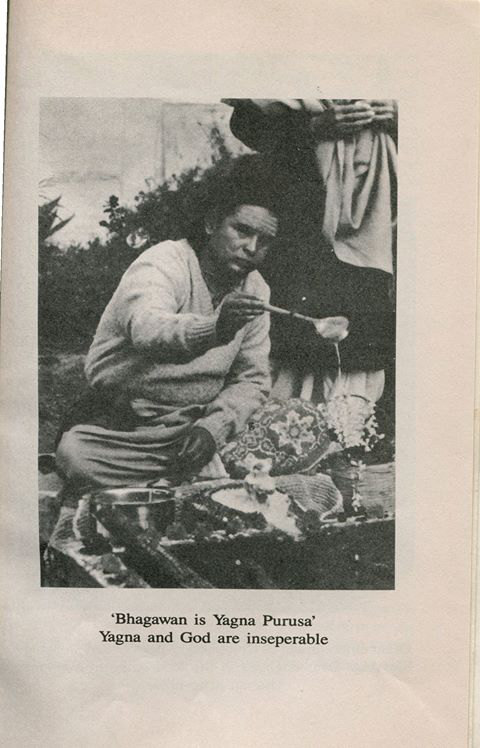
Great incarnation of Compassion — Bestower of profound blessing — Ever engaged in the welfare of all (Bābājī after 1970)

A PLEA FOR FORGIVENESS
The reports of Śrī Haiḍākhān Bābā are increasing day by day. The thought comes naturally to mind: what is this Divine Manifestation of Bhagavān? Though I am not able to understand Him fully, still, every time He has poured His wondrous grace upon us, not I alone but many other helpless people have had the conviction planted firmly in their hearts that Śrī Mahārāj is the full manifestation of Śrī Bhagavān.
A few days ago a man gave thirty thousand rupees, with no prompting from anyone, to build a temple for Him at Śrī Vṛndāvan.
Even ordinary people have known His wondrous and divine Grace in full; a complete account of it would fill volumes.
He has always been very kind to me. In 2006 (the year 1949), showing this humble son His true Divine Manifestation, He made him His own. But even before that, before I knew anything of His kindness, in the year 1936, when I was in the village of Rūpāl in Gujarāt, in the fourth month I fell ill with fever and blindness. Even then, after two days of illness, I found Śrī Mahārāj standing beside my bed and passing His hand over my head. My sight returned at once and the fever left me. I knew nothing of this myself, but a devotee had seen it in his dream. So be it! Śrī Śaṅkar has commanded, "Keep it secret, keep it secret, keep it secret with all your strength."
This boldness, then, which I have shown in writing of it, is only for the salvation of the world and to free His devotees from their doubts. Believe me, there is no other motive in my mind. Therefore once again I beg forgiveness of Śrī Bhagavān, of all the saints, and of His devotees. The incomparable blessings of Śrī Bhagavān are proof of His matchless embodiment. I am incapable and unworthy: what can I say of His immeasurable grace!
O Lord, Abode of Compassion, how long can I go on describing all the blessings Thou hast poured upon me, a helpless creature! O Lord of the helpless, even hadst Thou given me a crore of mouths with which to describe Thy Grace, even that would not be enough!
Om Shanti! Om Shanti! Om Shanti!
He who gives God second place gives Him no place at all

I do not want God's name to be stagnant muddy water, but like sparkling running water. This is possible when Japa Yoga and Karam Yoga are practised together. Peace, happiness and God's realisation is achieved by repetition of OM NAMAH SHIVAY. The call of Age is Karam-Yoga. WORK IS WORSHIP. In Kali-Age liberation will be granted by Karam-Yoga. One perfect Karam-Yogī is enough to change the world. To follow and spread the path of TRUTH SIMPLICITY and LOVE is man's supreme duty and the highest yoga. The confluence of the three components, truth, simplicity and love will give the full glimpse of Satyam, Shivam and Sundaram, the goal of life. JAI MAHAMAYA KI JAI — BABAJI
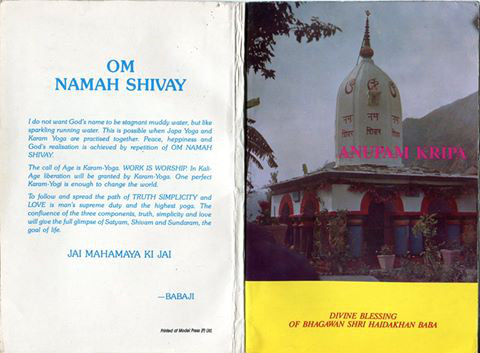
Translated from English into Italian by Natascia Valentini (Tara bianca).