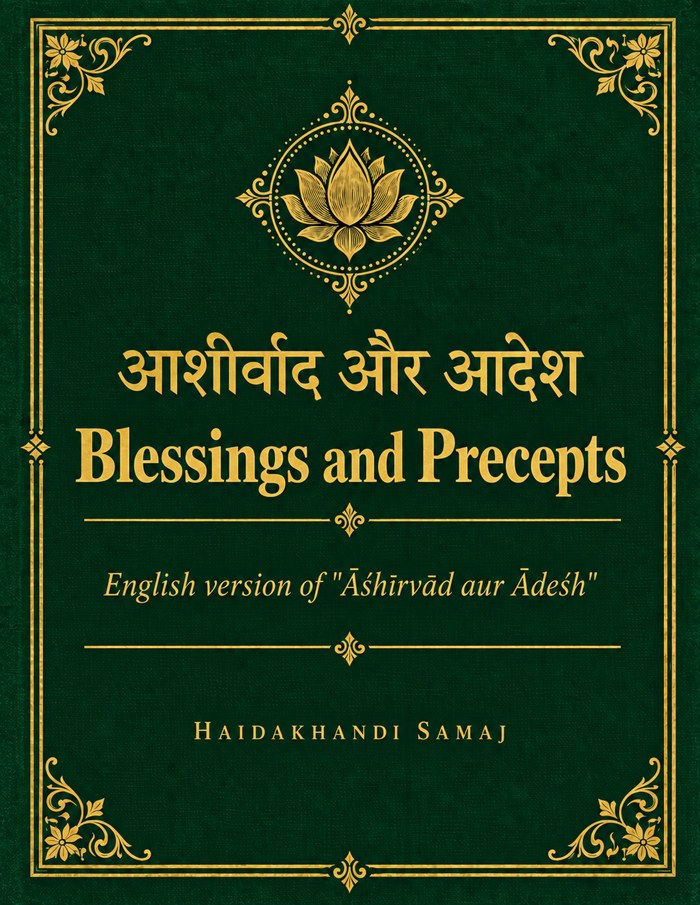
About this book
Not a story but instruction — thirteen short chapters on where devotional practice goes wrong, translated into English at Bābājī's own request.
- Author
- ”A Refugee at His Holy Feet” — Śrī Charaṇāśrit Bābā
- Translator
- B. C. Das, retired Professor, Allahabad University
- Contains
- Thirteen short chapters · about 11,500 words
- Read here in
- English only
The Preface states its own terms plainly: this is a translation of a book “written by His Holiness Sri Charanasrit Baba,” in which “Shri Shri Baba has brought out some esoteric principles of religion and has laid down some precepts.” It is instruction, not narrative — chapters that diagnose specifically where devotional practice tends to fail, and why the fault usually lies with the practitioner rather than the ideal.
What is inside
| Chapter | About |
|---|---|
| Preface | The translator’s own note on the book’s origin |
| Enlightenment | A short opening statement |
| Body and Creation | The physical basis of spiritual life |
| Harmony | Why mind, speech and act must cooperate — the book’s central concern |
| The Advent of Hostile Elements | What works against the aspirant |
| Deleterious Effect on Spiritual Welfare | The consequences of disharmony |
| Mansa Yoga | The yoga of the mind, and how the seeker actually reaches God |
| Come! Come! | An invitation |
| Peace — Peace — Peace | A brief closing invocation |
| Salutation to Sadguru | Homage to the teacher |
| Bhagwan Sri Hariakhanwale | On Bābājī of Haiḍākhāṇ directly |
| Siddhashram | On the sacred place of accomplishment |
| Instructions | Closing practical guidance |
The book’s central argument
The chapter Harmony states the book’s real concern early: “The natural attribute of creation is harmony. The created beings will obviously suffer destruction if the elements of their physical body be disorganised” — and the same, the book argues, is true of the inner life. Mind, intelligence, attention, ego and the senses must cooperate for a person to reach anything; where they pull apart, the spiritual life fails not because the goal was wrong but because the practitioner was divided against himself.
Mansa Yoga — the yoga of the mind — develops this further: “the Jeeva has always adopted, according to his taste, the practice to attain the goal of religion,” yet fails to arrive, because religion and God are properly matters of the mind, and it is there, the book insists, that the real work must be done.
Who wrote it
The author is credited as “A Refugee at His Holy Feet” — a pen name for Śrī Charaṇāśrit Bābā, the same Mahendra Mahārāj whose essays make up Parichayāmṛt and whose autobiographical Anupam Kṛpā is also on this shelf. This book is less personal than either — closer to a teaching manual than a memoir — and was translated into English, the Preface notes, “at Shri Baba’s own request,” by B. C. Das, a retired professor at Allahabad University.
What you are actually reading
- This is the English version of “Ashirvad aur Adesh,” translated by B. C. Das, offered as a standalone English edition rather than alongside a Hindi original.
- Written, the summary notes, for anyone inside or outside a tradition — not addressed only to existing devotees.
If you are deciding where to start
Read this if you want teaching rather than story — direct instruction on where devotional practice actually fails, from one of the tradition’s central authors.
Read Parichayāmṛt or Anupam Kṛpā first if you want to meet Mahendra Mahārāj as a person before reading him as a teacher; this book assumes no introduction and gives none.